
🔵 TREND RADAR #20 :: TECH DRIVERS
Soft Optimization in a Surveillance State

In today’s Trend Radar recap, I’ll be sharing a some recent signals from my database that are influenced by the Technology drivers space.1 This covers three macrotrends: Functional Optimization, Synthetic Expression, Creative Codebreaking. Emerging ideas include: Surveillance Culture, Soft Optimization, and Brand Fan Fiction.
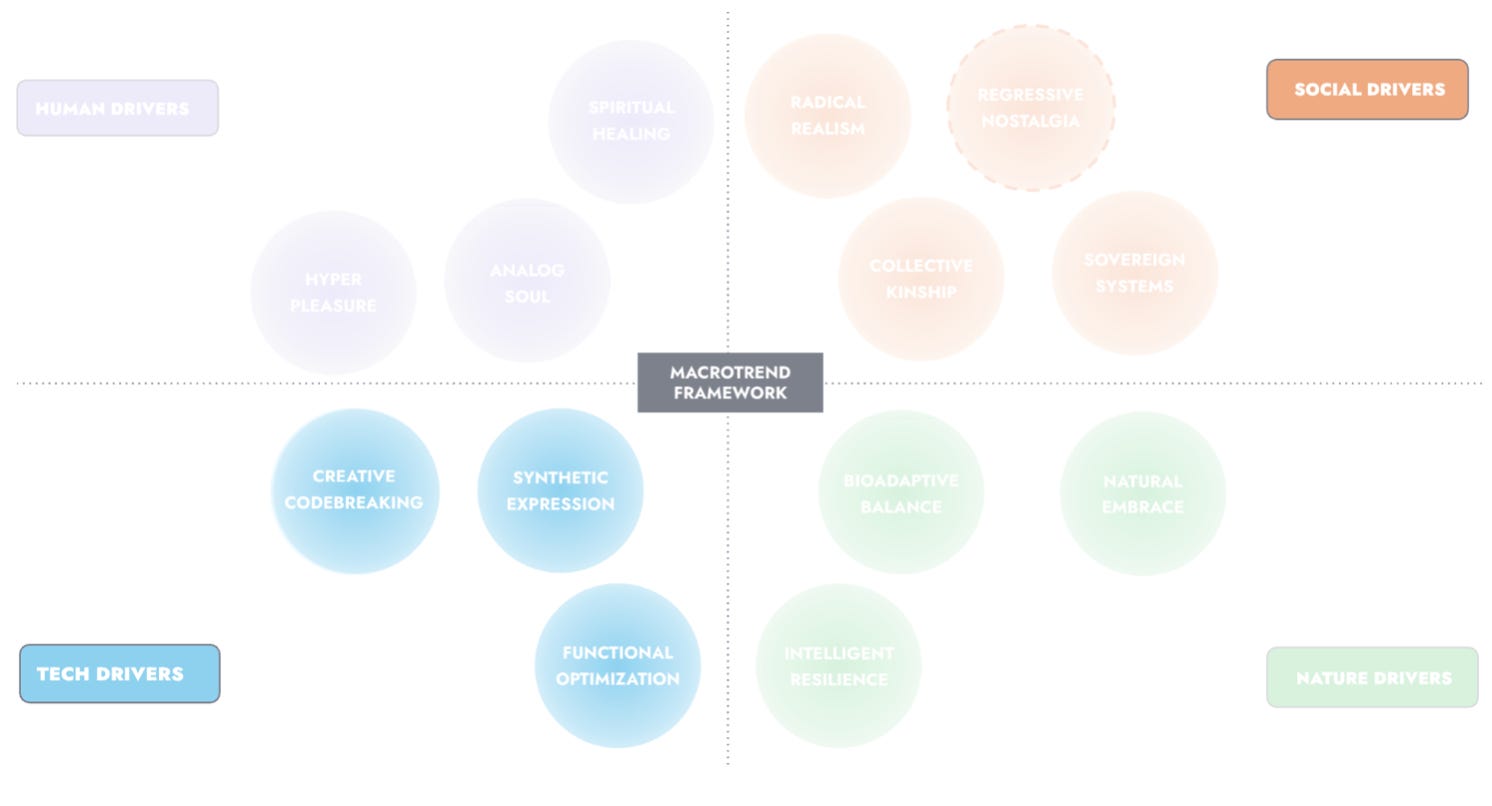
For an overview of the Macrotrend Framework, read this post or watch the webinar:

[EMERGING] SURVEILLANCE CULTURE
Over the past month, we’ve seen Meta and Snap launch new smart glasses, tapping celebrities like Kylie Jenner and Jack Harlow for their campaigns, and throwing parties with the likes of Peggy Gou. As Alexi Gunner writes, “In both cases, the vibe has noticeably shifted. Wearables are no longer positioned as state-of-the-art gadgets for nerds, but as credible fashion accessories for tastemakers.”
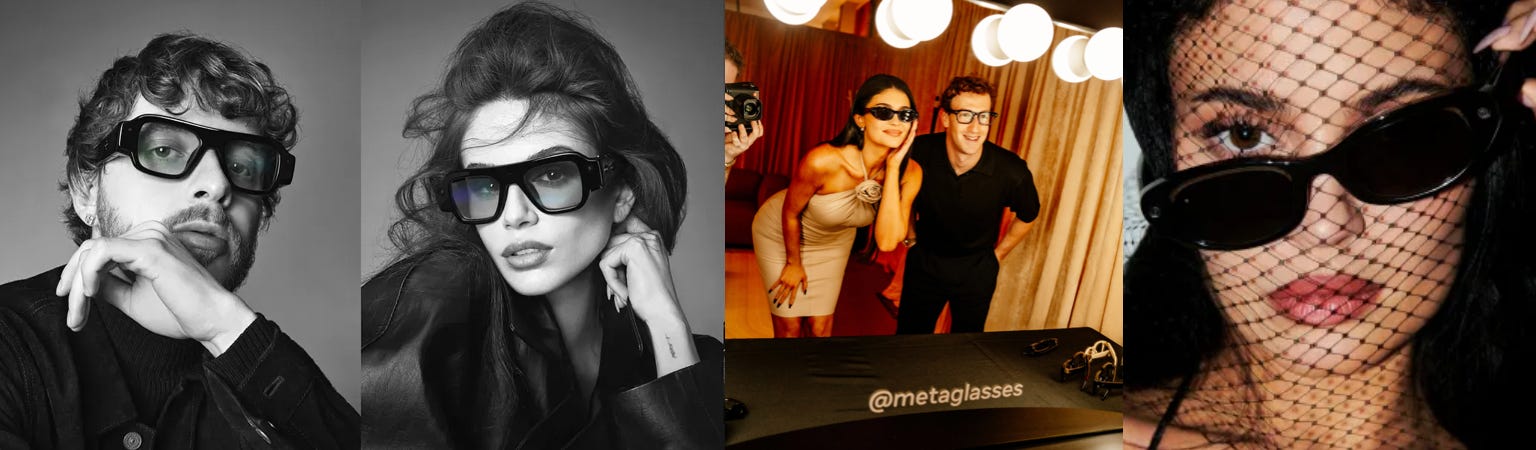
The attempt to legitimize smart glasses through cultural relevance is similar to the strategic playbook that Anthropic has been using to position itself as the ‘cooler’ AI company, and that Polymarket tried tapping into with its recent Rick Rubin ad. This is the result of all that tech bro taste discourse: they discovered cultural strategy. Whether they’ve executed successfully is debatable — it’s mostly just giving tasteslop. And as I’ve written before, elevating brand perception has its limits when the public despises the product for valid reasons.
By marketing metrics, the smart glasses campaigns were successful, leveraging alignment with fashion and music icons to create buzz. But the buzz was mostly backlash — a predictable response considering the percolating techno-pessimism and anti-AI sentiment that’s already been building in culture over the past year. Sociotechnology expert Dr. Sarah Saska explains to Vogue Business, “the more politically controversial AI becomes, the more aggressively it’s feminized.” Unfortunately for tech companies, “fashion may be able to lend desirability, but it can’t overcome distrust on its own.”
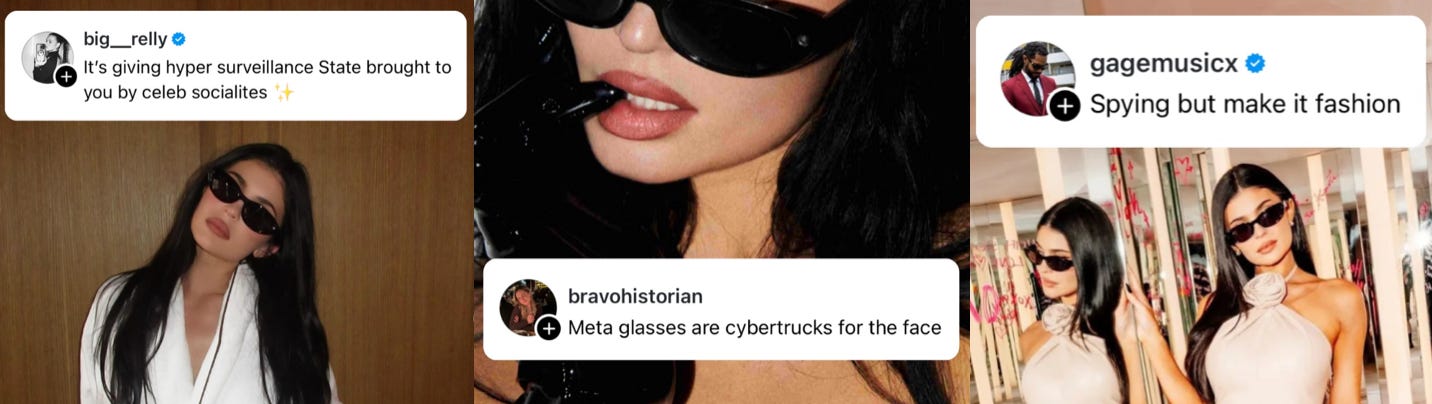
Much of the public outrage points to the obvious risks to the privacy and safety of women, children, and other vulnerable groups. But Saska argues that focusing only on these immediate (and very real) issues potentially “shrinks the problem to one creep on a train taking a picture, when the structural danger is always-on cameras becoming ordinary, human workers reviewing footage, and data pooling in an ecosystem owned by one company. Once that hardware sits on millions of faces, it becomes infrastructure that police, immigration agencies, employers, and the company itself can draw on. The creep is one manifestation of a much larger system.”
Gunner points out that growing paranoia about a surveillance state has fueled a “cottage industry of anti-surveillance solutions,” like cap_able, CV Dazzle (and others that I’ve previously highlighted as part of Algorithmic Evasion and Wearable Defense), as well as a rise of live venues adopting no-phone policies. And yet, simultaneously, some brands and influencers are engaging with the aesthetics of surveillance culture, "utilizing grainy CCTV, spy-cam footage and facial-recognition overlays in campaigns and social content, as a way to subvert the hidden, all-seeing gaze that accompanies increased digital monitoring.”
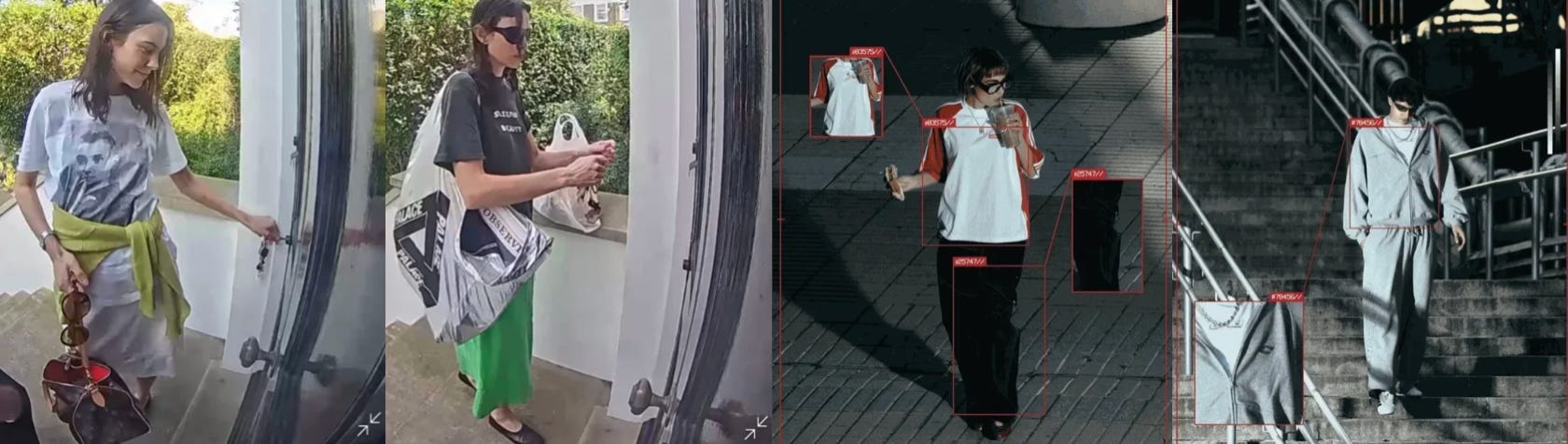
This stylized surveillance framing prompts the question of whether superficial subversion actually functions as a form of reclamation/resistance, or simply contributes to normalizing the visual elements of surveillance imagery by divorcing aesthetics from context.
And so brands and creators have a choice: they can continue to subvert the visual language of surveillance, or challenge the technologies encroaching on society and offer a sense of privacy away from the prying eyes of the digital panopticon.
In another aspect, we’re seeing the mechanics of surveillance infiltrate peer-to-peer dynamics. A recent and obvious example is Substack’s partnership with Pangram, an AI detection software, which encourages readers and writers on the platform to scan essays to determine whether AI was used to write them.

Considering that many people vocally dislike consuming AI-generated content, this may seem logical (although this particular software’s accuracy remains debatable). But in a recent note, chandra calls the move “community surveillance,” and that resonated with me — it feels like a ‘neighborhood watch’ situation, and signals a new iteration of ‘cancel culture’ revolving around contentious AI usage claims. We might call it Surveillance Culture.

This issue of the newsletter is sponsored by Tracksuit, the always-on brand tracker built for marketers and agencies to answer the question “Is my strategy working?”
Functional Optimization
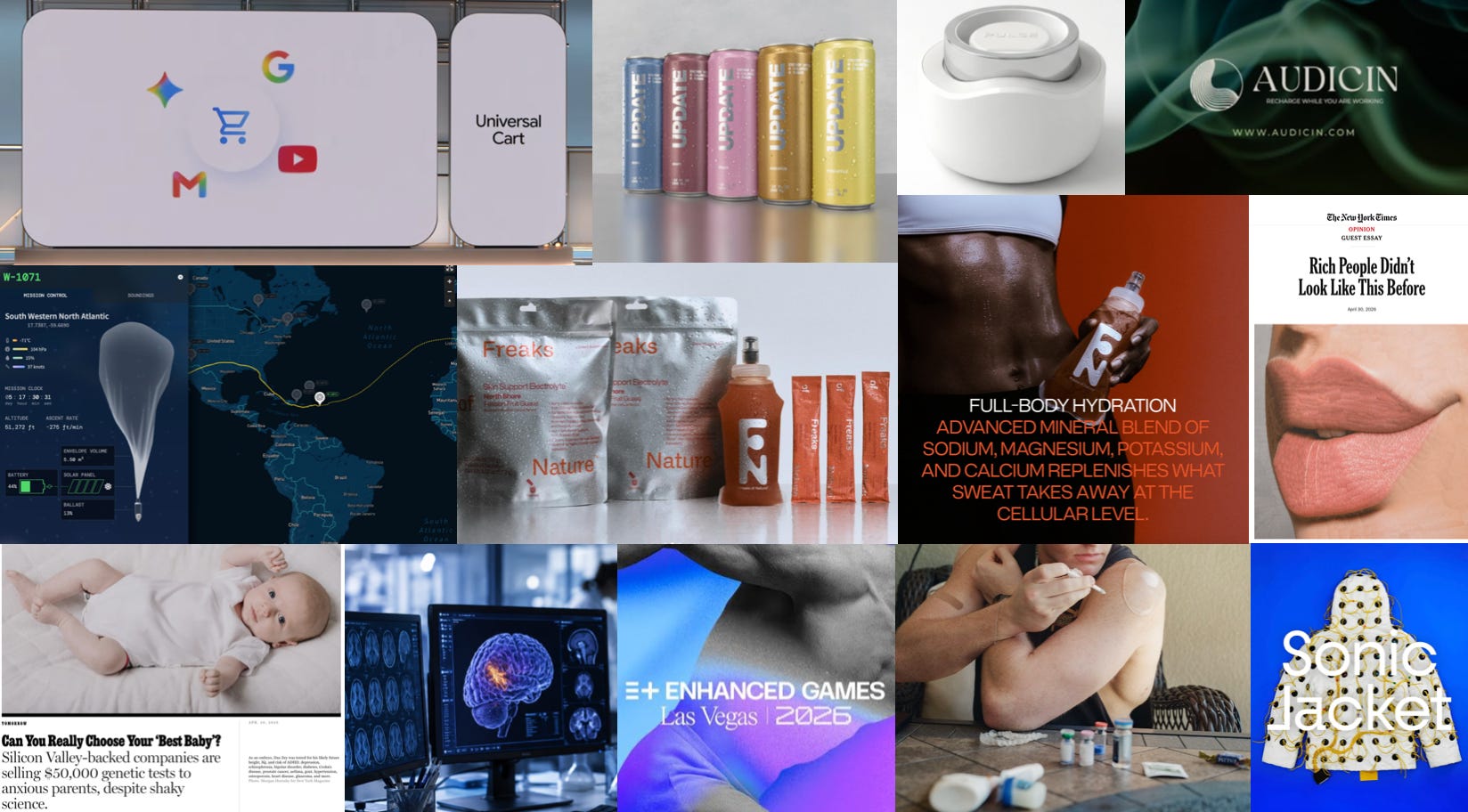
Surveillance pricing, or algorithmic personalized pricing, is moving from e-commerce to grocery stores.
Google launched Universal Cart, an AI tool that enables shoppers to add items from across merchants and platforms to a single cart, which will then “search for discounts, aggregate price history and notify shoppers when out-of-stock products are available again.” And a new app, The Mall, is building a universal feed for shopping: “users create their own virtual mall by adding their favorite brands upon signing up.” Meanwhile, Verneek is a startup that is provides AI-powered operational solutions for retailers.
The Selling Network is a resale listings tool that uses AI to automate the process for sellers to list items across the many secondhand marketplaces online.
Chris Danton recently highlighted new activity in the ingestible skincare space, which is “projected to reach $13B by 2034 and is growing faster than topical skincare” — Freaks of Nature and Kylie Jenner both launched skin-enhancing electrolyte powders, while Heliocare and Timebeam make oral sunscreens. I’ve been tracking ingestible beauty for a while (and I actually took a skincare supplement regularly between 2020-2025; I loved it and I’m sad that it’s discontinued), but I think we’ve finally reached a point where people are primed for this to succeed, since supplement stacks have entered the mainstream. Five years ago you had to convince people that it’d be worth kickstarting a new habit, but today you’re simply selling an addition to an existing routine.
Speaking of electrolytes, one of the leaders in the Hydration Products category is Liquid IV. According to Tracksuit, the brand’s awareness jumped from 45% to 52% over the past year, while consideration has increased 5-percentage-points from 30% to 35%. When it comes to brand perception, Liquid IV wins the category on innovation — Amongst people aware of the brand, 37% believe it’s innovative.
Considering the boom in beauty-focused electrolyte products, there’s clear potential for Liquid IV and other hydration-focused brands to explore this as an area for potential growth and innovation.
According to Dazed, caffeine is Gen Z’s drug of choice, with rising consumption of the stimulant, a boom in new energy drinks, and interest in newer form factors like pouches and powders.
New York Magazine covered the rise of controversial Silicon Valley-backed companies using genetic testing to enable choosing your “best baby.”
A team at MIT launched Fingers-7B, an AI model that can “help make Alzheimer’s preventable by identifying people at risk earlier and more accurately.”
Amy Odell wrote about how the prevalence of cosmetic surgery has defined a new type of “rich face” that is “stretched taut, often incapable of varied expressions and plumped with filler or implants or a person’s own grafted fat.”
Attention towards optimizing sperm health continues to gain traction among men, probably the same ones who are experimenting with peptides in search of perfection.
The Enhanced Games took place in May, allowing athletes to use various drugs and equipment to optimize their performance. Meanwhile, Sony built a robotic arm that can win competitive table tennis against elite human players.
Semafor reported that an AI weather forecasting startup, Windborne Systems, has outperformed leading government-run forecasts.
[EMERGING] SOFT OPTIMIZATION / HOLISTIC ENHANCEMENT
For years, I’ve been tracking a subset of sporadic signals that seek to improve wellbeing, but in less aggressive way than most of the others that fit within Functional Optimization. Instead, these signals often leverage elements of our natural biology or integrate intuitive healing modalities, so I’d often feel they were more culturally aligned with the Bioadaptive Balance or Spiritual Healing macrotrends.
But recently, as we’re beginning to see some exhaustion from over-optimization, I’ve noticed a growing influx of these types of signals, and it feels like they are coalescing around a sensibility I might call Soft Optimization, or maybe Holistic Enhancement: integrating technology with concepts drawn from nature and ritual to offer more gentle ways to continue pursuing improved wellbeing.
Pulse is a smart ring that tracks zero data but aims to encourage mindfulness through timed vibrations that signal moments to pause.
We’re seeing more and more functional fragrance concepts that claim to benefit health and wellbeing.
An audio platform called Audicin helps users passively regulate their nervous systems in the background of everyday life, by leveraging psychoacoustic protocols that blend original compositions, precision-engineered binaural frequencies, and immersive spatial sound.
Even Vollebak, an experimental brand that’s always been on the leading-edge of extreme optimization with indestructible jackets and graphene tees, has retreated to a softer approach with its recent launch: The Sonic Jacket aims to “change how people feel by sending sound waves through the body.”
The Morphus lounge chair I mentioned last week fits here too — it’s “embedded with stress-regulating tech—light therapy and inaudible sound waves.”
WHAT’S ANU is a reader-supported alternative trend resource.
Paid subscriptions unlock access to all past posts, occasional exclusive content, the complete 2026 Macrotrend Report, Quarterly Updates, and the Research Database.
Your support is appreciated!
Synthetic Expression
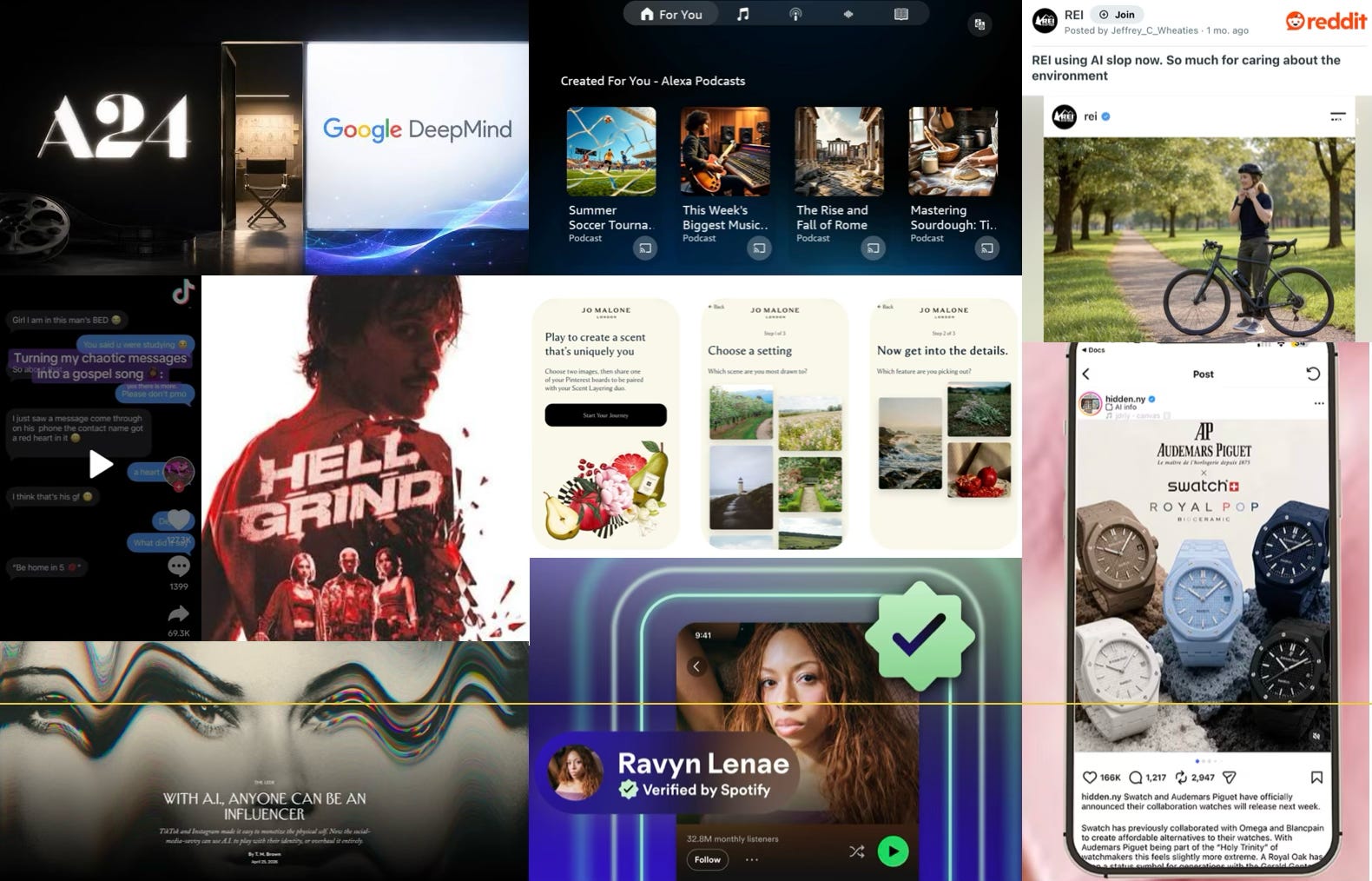
In June, a fully AI-generated movie debuted at Marché du Film in Cannes: A fully AI-generated movie will debut at Cannes this week. Hell Grind is a 95-minute action adventure film produced by San Francisco AI startup Higgsfield AI on a $500,000 budget (of which $400,000 was spent on AI compute costs). Variety’s reviewer described the plot as “nonsensical” but was impressed by the visuals.
After announcing a partnership with Google Deepmind to develop AI-powered filmmaking tools, A24 predictably received a barrage of backlash from their most loyal fans — because AI’s brand perception problem is every brand’s problem. An angry commenter lamented that the film studio had “sold its soul,” which circles back to the overarching thesis of my 2026 Annual Report: A Return to Soulfulness.
Prior to the Google Deepmind announcement, Tracksuit data as of May 2026 confirmed what most of us might have assumed about A24’s brand perception: it’s well-liked. Amongst people aware of the production company, it leads the category with the statements “Is passionate about what they do”; “Is really on the way up”; “Is a trendsetter”; “Is unique”; and “Is innovative”. Specifically for the statement “Is innovative”, 51% of people associate it with the brand, compared to 37% for Netflix and 39% for Neon.
We’ll have to check back in several months to see whether the recent AI backlash has a perceptible impact on its brand image.
In a similar vein, REI received backlash for using AI in an Instagram ad depicting a bike with two sets of handlebars — although apparently the creative decision didn’t come from the company. Its spokesperson claimed that “Meta auto-enrolled us in an AI personalization tool that produced an inaccurate and inappropriate alteration of a vendor-provided image in some of our ads.” Whether or not the excuse was truthful, the controversy emphasizes that brands need to keep close tabs on their creative outputs to avoid these types of mixups.
Amazon added capabilities to its Alexa assistant that enables it to generate podcast episodes: “turn any topic you’re curious about into a podcast episode, ready in minutes.”
Jo Malone launched Scent Scanner, an AI-powered tool that enables Pinterest users to translate visual moodboard imagery into personalized fragrance recommendations.
Suno’s ability to turn texts into songs gained traction via Tiktok, and the feature can now be used directly within iMessage. More recently, a hacking incident uncovered evidence that the company illegally trained its product on millions of copyrighted songs scraped from YouTube.
We’ve seen social media platforms like YouTube and Instagram begin to label AI-generated content after consumer complaints about the slop filling their feeds. Spotify took the inverse approach by launching a verification system to distinguish human musicians. This relates back to the Substack/Pangram partnership I mentioned earlier.
Teddy (T.M.) Brown wrote a great piece on the wild west of AI influencers back in April, and in June a New York State law went into effect that forces disclosure of “synthetic performers” in advertisements.
Circling back to the Substack’s Pangram integration, I’ve seen several notes about how the tool’s many false positives are now forcing writers [who don’t use AI] to rewrite their work or alter their style specifically to avoid being flagged as AI. To this effect, I enjoyed this linguistics deep dive explaining how the core issue with AI detection tools is rooted in the fact that LLMS were trained on human-produced text of a specific cultural timeframe, and are thus “reproducing patterns that were already trending in that training data.” AI is synthetically emulating human writing, which is now forcing human writers to alter how they write. There’s something fascinating about how a machine might forcibly change the the trajectory of an art form. We could perhaps think about this in parallel to how the onset of photography acted as a catalyst in painters’ shift away from representational styles and towards abstraction.
According to a Yale Youth Poll, Gen Zers vastly overestimate their ability to detect AI-generated content. Similar findings were confirmed by a wider national YouGov survey commissioned by Zine, which investigated people’s exposure, detection, and actions in regards to AI content, and highlighted differences across generations, gender, and politics. Matt Klein comes to the conclusion that, “Our perception of AI is shaped more by identity than reality itself.” This tracks with what I wrote last year about the emergence of a Post-Reality landscape.
As part of his analysis, Klein found that ““Americans now default to ‘This is fake’ six times more often than they default to ‘This is real.’” Connecting this to Vulture’s clipping feature, “The Feed is Fake,” and speculation about a fast-approaching “influencer cliff,” Chris Danton suggests that this dramatic decline in trust spells bad news for short-form content:
When this level of negative sentiment happened to traditional TV spots, the industry never made it back. If you’re a brand whose entire brand strategy and revenue streams come from social, I’d be looking hard at my mix. And if I were Instagram and TT, I’d be diversifying too.
[EMERGING] BRAND FAN FICTION
In anticipation of the Audemars Piguet x Swatch Royal Pop collaboration this past spring, brand fans prompted a deluge of memes and AI-generated images speculating about what the product drop might look like. This confused customers who were excited by the mockups but disappointed “when the real product didn’t match the internet’s imagination.” Business of Fashion argues that this can be challenging for brands that traditionally adhere to “tightly controlled image-building and carefully orchestrated rollouts.”
Michael J. Miraflor has noted that the AP x Swatch situation is similar to what we saw a few years ago with the Tiffany & Co x Nike collaboration, and emphasizes that this will inevitably continue. He calls this phenomenon AI Brand Psychosis: excited customers creating “AI-generated mockups and visions of what a product could be” that inevitably “outshine the actual, deliverable product. The disconnect creates an illusionary brand reality that the company and public can struggle to reconcile, [sometimes] resulting in unmet consumer expectations.”
I prefer to think of it as Brand Fan Fiction, similar to what we’ve seen for years in the entertainment world. But I agree with Miraflor’s overall assessment that these viral mockups are “an indicator of deep brand love that can be potentially leveraged in new and novel ways. Maybe as a form of product research? Co-creation with super fans who are also savvy AI designers? Work with LLM owners to understand this type of fandom better? Does this reframe the authority of the brand vs the “wisdom” of the crowd? …It’s a whole new world of possibilities out there.”
If you’re enjoying this post, please consider liking, commenting, or sharing.
Creative Codebreaking
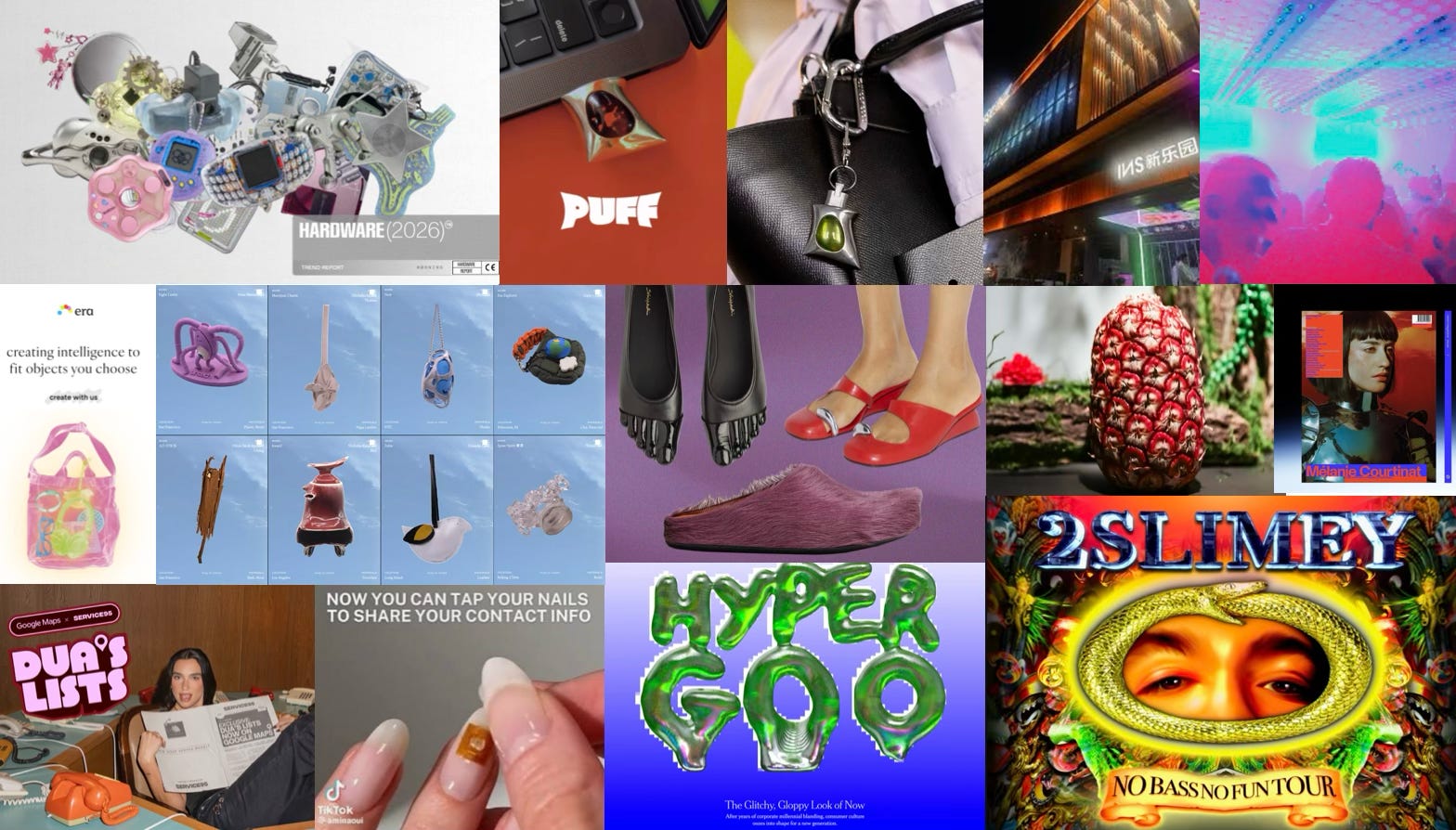
There’s been a lot of buzz in the hardware space that fits within this macrotrend, like the cyberdeck craze. Nick Susi re-published his essay, “music hardware is a fashion accessory,” and I’m enjoying MØRNING’s recent report on the subject, which includes several emergent examples of creative hardware innovation. I think Nothing has been one of the most impactful new tech brands exploring this shift in mainstream applications. A more niche signal I stumbled upon while scrolling: Puff is a “designer flash drive” by noware that features 128GB of flash storage and can be worn as a pendant, bag charm, or key chain.
Meanwhile, Era is a technology startup that “builds the intelligence layer for physical devices. The platform that lets anyone — a jeweler, a musician, a car designer, a fitness brand…shape how an object listens, thinks, speaks, acts, and remembers.” The company’s software platform help hardware makers develop AI agents and orchestrations to create AI-enabled devices.
The viral popularity of NFC chip nails offer a more [fun]ctional example of what “wearable tech” can mean.
Rooted in Algorithmic Evasion, we’re seeing more explorations of anti-algorithmic discovery engines. One example is Google Maps collaborating with Dua Lipa to bring her travel recommendations into the app, with 12 curated lists of her favorite spots across cities including London, Tokyo, and Barcelona.
The New York Times ran a feature about the “Glitchy, Gloppy Look of Now,” highlighting the shift from Millennial minimalism to Gen Z’s gooey, blobby, hyper-saturated, distorted maximalism. I wrote about my perspective on Gen Z maximalism in more depth in this piece from last year.
Mandy Lee @oldloserinbrooklyn has been a consistent proponent of “freaky shoes,” and the fashion trend now seems to be hitting its stride — for men, too.
Fresh Del Monte and Dole have developed “premium pineapples” with unusual flavors and colors. Rubyglow, for instance, is a red-skinned hybrid between a traditional pineapple and the Morada variety, and sells for up to $395 per fruit.
If the “glitchy, gloppy” visual aesthetic was translated into sound, we might call it “music maximalism.” That’s how Dazed describes the emergent genre of “internet music” that “sounds like an Italian brainrot meme,” with unintelligible lyrics and purposeful distortion, as exemplified by controversial LA-based rapper 2Slimey. In another essay on the topic, Giorgia Aubrey argues that it “might just be the closest thing we have to a new age of punk.”
THE CHOW spotlighted INSLand, a Shanghai nightclub designed to feel like a video game, and discussed the broader concept of gamer-inspired nightlife.
Netflix announced the launch of a new interactive horror game experience called Unhinged.
Reset is a new gaming magazine that explores the aesthetics and cultural context around video games.
As part of its comeback campaign targeting Gen Alpha, Claire’s partnered with Roblox creator Lana Rae.
Vaseline’s Originals collection is a fantastic example of how brands can tap into community co-creation: They developed products in partnership with Tiktok creators Jen Chae and Lauren Luke, whose videos popularized Vaseline-based beauty hacks, and compensated them with a discretionary share of sales. After selling “one product every two seconds” in the first month of the collection’s launch, the brand used social listening to identify “more than 3.5 million posts of unconventional Vaseline,” and is continuing to translate these concepts into commercial products.
Salomon is similarly turning product development into a community design exercise with its Road to the Future program, in which eight emerging Chinese designers reinterpret existing Salomon silhouettes, with the winner securing a long-term collaboration with the brand. The final designs are exhibited at the brand’s Shanghai store, where visitors can vote for their favorites.
More evidence continues to confirm what I’ve previously dubbed Chaos Overload — from the Met Gala crossing over into cringe, to the overwhelmingly negative sentiment towards brands’ predictable memeification of the viral Empire State Building proposal stunt. Side Projects correctly clocks this as the “banality of spectacle,” pointing out that “part of the reason spectacle feels so mundane is because it’s become so ubiquitous. It exists in policy and propaganda, where the war in Iran, ICE raids, and political violence are packaged up into brainrot, revealing a gleeful fetish for violence and casual cruelty.” And as an advertising strategy, while chaotic memes and collaborations might provide a short-term boost in largely meaningless social media metrics, the long-term outcome “risks knee-capping credibility.”
As Chaos Overload crystallizes, it’s worth taking a closer look at Duolingo, the heavily referenced posterchild of Chaos Culture-inspired meme marketing. Tracksuit’s data indicates that, from May ‘25 to April ‘26, all brand health metrics have spiraled downwards, including Consideration (45% to 38%) and Preference (29% to 24%). Its top-of-funnel conversion, or the rate people move down from awareness to consideration, also decreased during this time period from 82% to 75%.
Maybe that’s part of what pushed Duolingo to announce a shift in strategy, telling Business Insider that they’re pivoting away from ‘unhinged’ content.
Tracksuit is a brand health tracking platform that gives marketers continuous, always-on visibility into how their brand is performing on the metrics that predict long-term revenue growth.
Explore the complete Trend Radar Archive, organized by category:
🟣 Trend Radar: Human Drivers
🟠 Trend Radar: Social Drivers
🟢 Trend Radar: Nature Drivers
🔵 Trend Radar: Tech Drivers
I’ve primarily limited signals in this recap to Q2 (before July 1, although there are a few exceptions), to keep it from getting too out of hand since it’s already sooo long. The next Tech edition will incorporate July’s signals. Sorry that things have fallen a bit behind!
Amazing and in-depth piece. I was already thinking about putting something together on surveillance culture and the fact how we're slowly trying to cancel it by moving more private but I think your pov is much sharper and very on point.
music hardware is a fashion accessory 🎧🤍🎧