
25.5 ASPIRATIONAL HUMANITY
Soulfulness as luxury

Back in January, I wrote about Offline Escape as a key trend for the year, situated within the larger macrotrend of Analog Soul. The essay ended with a note about how we’d likely be seeing further manifestations of anti-technology sentiment:

Over the past few months, while developments in AI have continued to rapidly accelerate, we’ve indeed witnessed a rising consumer backlash. Although people love using technology to simplify life and cheat on everything, they aren’t always quite as keen on synthetic slop and aesthetic repetition.

As media companies (Spotify; Netflix; Disney) flock to reduce costs by integrating artificial intelligence, we’re inevitably hurtling towards a compression of creative culture folding in onto itself. AI will only further escalate the flattening effect of algorithms and the stagnating effect of decontextualized visuals. The antidote to cultural compression is identifying and amplifying the essential qualities differentiating authentic from synthetic; distinguishing humanness from technology. As artificial intelligence hyper-flattens mass culture, anything denoting evidence of humanity becomes aspirational.
I haven’t decided yet whether Aspirational Humanity sits within the Analog Soul macrotrend, or if it has actually overtaken Analog Soul as the macro. Would love to hear what you think in the comment section.

When I first conceptualized Analog Soul several years ago, it had similar drivers, fueled by a desire for humanistic integrity in response to digital fatigue and algorithmic overwhelm. The keywords in my original deck from 2021 are:
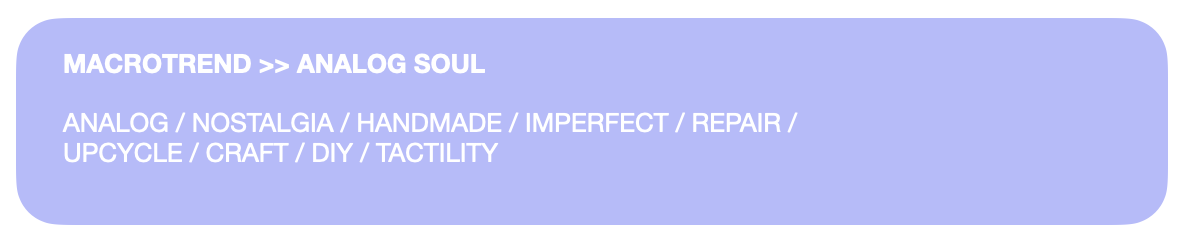
These all still ring true, but the drivers have intensified. The evolution towards Aspirational Humanity comes from how the current technological landscape intersects with socioeconomic stratification.
Artificial intelligence promises unprecedented efficiency, which means it will have the most dramatic effect on mass market cultural output. Industrialization enabled mass production of consumer goods and thereby elevated the value of handcrafted goods as luxury, while artificial intelligence now enables the same disparity in creative cultural output. This gap will grow wider than ever, as mass anchors to optimization and luxury aspires to soulfulness. In the unfortunate future state that our techno-oligarchs are marching towards, the masses will consume AI slop while anything human-created will be preserved for the exclusive enjoyment of the elite.
If you spot a detour to escape this route, lmk…
In the meantime, there is clear potential to strategically leverage the trend towards Aspirational Humanity.
While mulling over this for several weeks, I’ve come across several writers who have deftly explored some of these dynamics and identified actionable near-term implications in a variety of contexts. I wanted to pull some of these ideas and strategies together below, organized as they relate to various business functions (Merchandising, Design, Content, Experiences), while adding my personal perspective where relevant:
Strategy & Merchandising: Discernment, Intuition, & Narrative
The overall consensus — everyone thinks taste is a strategic saving grace.
What we really need is more curation—the cultivation and deployment of personal taste.
In a world of scarcity, we treasure tools. In a world of abundance, we treasure taste.
In an age of mass production, curation and taste matter more.
Every single one of these articles are great reads, and I agree with them in theory — but it is problematic to rely on ‘taste’ as strategy without interrogating: who defines what is considered ‘good taste?’ Throughout history, creative works originating in the Global South were regularly deemed unworthy, ostentatious, or essentially of “bad taste” - until they were recontextualized through a European lens. I’ve written about this more thoroughly here, but the TLDR is:
We have been societally conditioned to perceive “good taste” in alignment with a very specific set of Eurocentric aesthetic principles.
Still, I believe that the concept of taste is valuable. But I also think it’s important we acknowledge it can be just as biased as algorithms. I propose that it may be more helpful to break down the core components that make taste so appealing (Discernment, Intuition, Narrative):
Discernment: The principle of editing. AI is a machine of mass creative production, ergo the onslaught of slop. In the midst of this overabundance, Sangeet Paul Choudary explains how “value migrates to those who choose carefully and act selectively.” But I want to clarify that restraint does not necessarily mean minimalism; it means specificity. Its power comes from defining a sharp and specific point-of-view, and maintaining laser-focused conviction in executing that singular vision (without the distraction of whatever is trending at any given moment).
Intuition: This is about respecting emotional integrity. Intuition speaks to the elusive potency of emotional subjectivity, while extricating it from the complex societal construct of taste. I also like the way Zoe Scaman frames this as an embrace of Primal Intelligence — “the most powerful brand experiences aren’t always logical, they’re felt.”
Narrative: Storytelling is a vital facet of our human history, and that isn’t going to change. While AI enables us to create anything at any given moment, we’re still the ones giving it prompts. Anu Atluru writes, “We will always seek the human fingerprint—not just the how, but the who and why.” Conveying the meaningful narratives behind strategic, editorial, creative decisions will be key.
Design & Aesthetics: Tactile Imperfection & Unique Personality
This expands on my earlier point that suggested a growing reverence for handmade qualities, human imperfection, and tactility as key differentiators. Overall, I think barr balamuth’s recent essay for The Sociology of Business does a great job of articulating the aesthetic manifestation of Aspirational Humanity:
When AI perfects mimicry, imperfection becomes precious. In the arms race for authenticity, human fingerprints are the new luxury.
Tactile Imperfection: Evidence of human craftsmanship comes from purposeful incongruity. Balamuth references one of my favorite brands, Kartik Research, as an example, explaining how they create: “garments where imperfection functions as authentication - 19th-century kantha embroidery with visible stitches, sun-faded natural indigo patches that reveal their handmade dyeing process, and deliberately uneven hems that document their maker's hand. Rather than hiding production variations, Kartik celebrates them - each hand-loomed textile, plant-dyed fabric, and hand-embroidered element becomes a built-in certificate of origin.” In product design across categories, these sorts of handcrafted qualities will distinguish humanness to justify higher value.
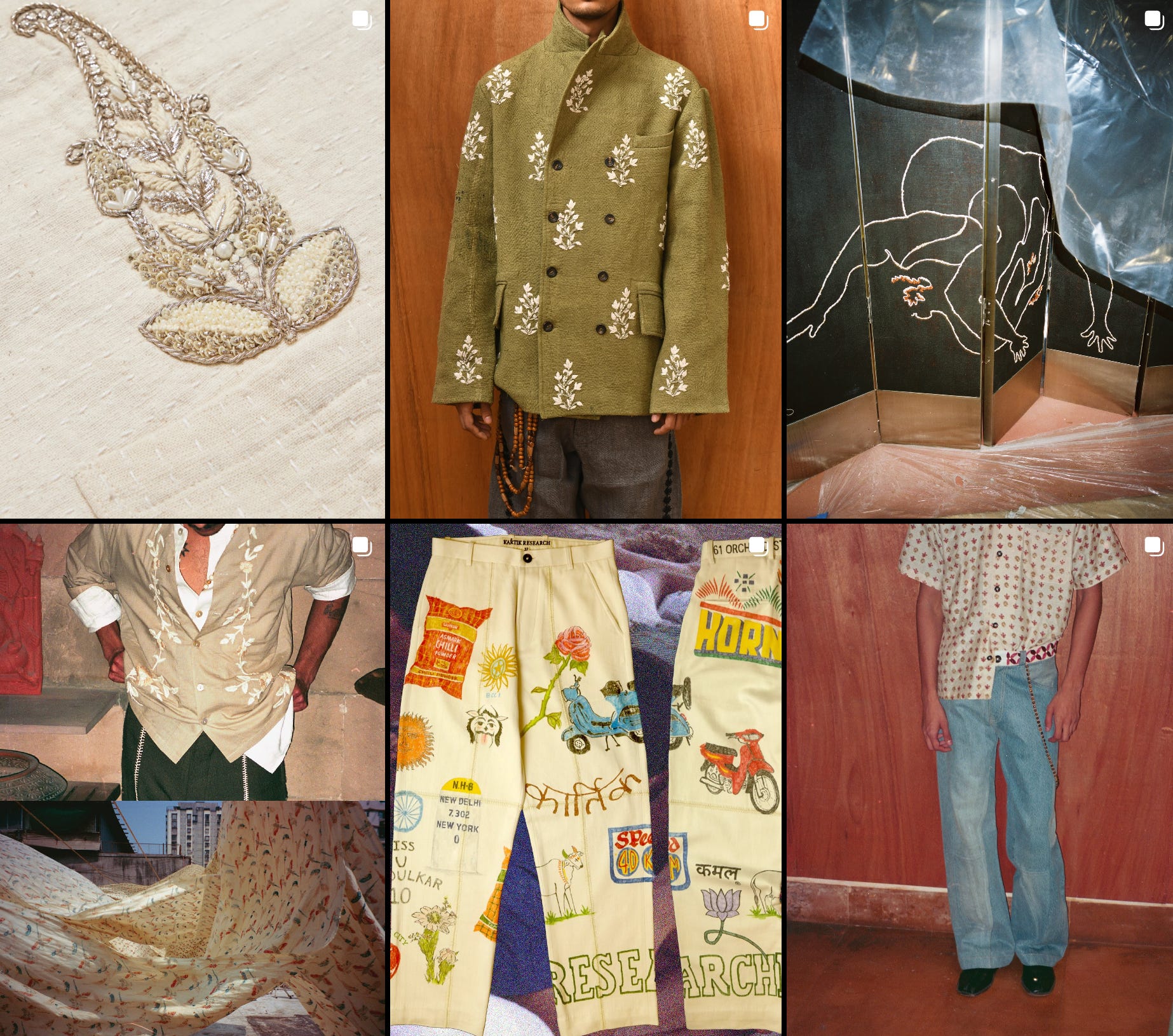
Translating this ethos to 2D visual culture and brand design, I think we’re seeing the rise of a sort of sentimental maximalism.
Unique Personality: Aesthetic design choices that convey an idiosyncratic perspective. I was very interested by this recent Dezeen article about how the “hunt for personality” is driving a booming demand for vintage art deco styles that is beginning to outpace “mid-century modern’s dominance in the secondhand furniture market.” And not just because I love art deco (I do, though). But the article notes that, essentially, MCM styles are too easily replicable by mass furniture brands, which is devaluing the aesthetic in comparison to other options that are more identifiably unique and possess a sense of personality.
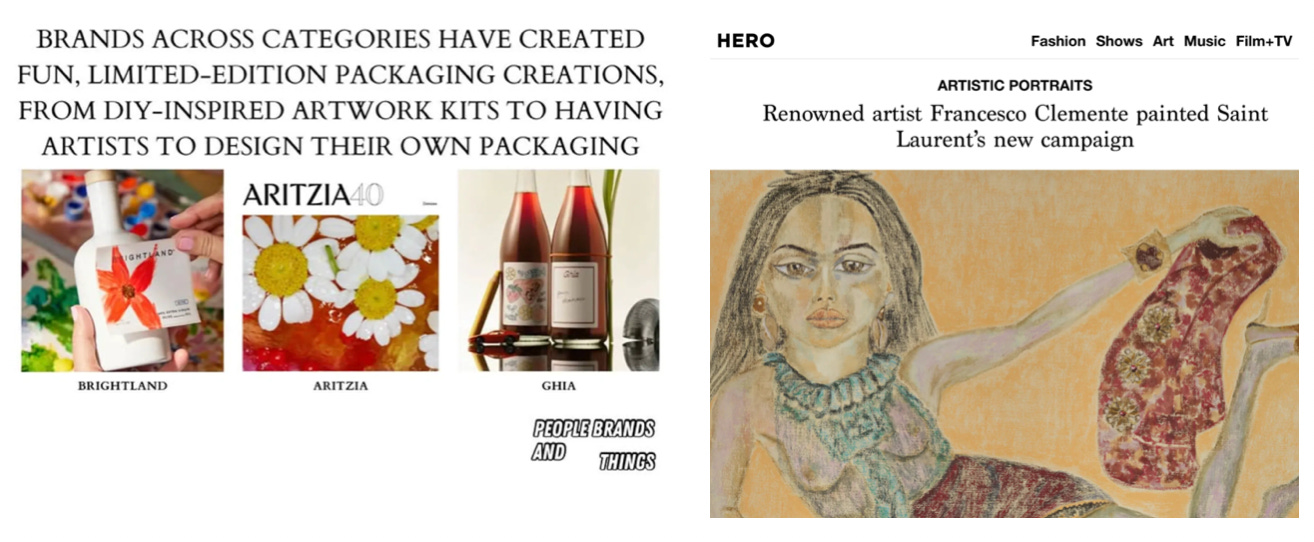
From a brand design perspective, we’ve similarly been seeing the pendulum swing away from blanding and towards more distinctive expressions of identity over the past few years. I think that will continue, but AI will make it increasingly difficult to find ways to differentiate. An approach that has recently been trending among fashion brands is incorporating painting, illustration, and textural interest in campaign imagery.

Content & Communications: Proof-of-Reality
The shift towards demonstrating “proof-of-reality” in creative content is best explained by Rachel Karten:
Once AI-generated images become imperceivable, how would brands signal that they don’t use it?
I predict we’ll see more posts like Apple TV’s BTS of how their camera operator got a very impressive shot in The Studio. Chamberlain Coffee captioning how their claymation campaign came together with “handcrafted, just like our coffee.” Topicals simply tagging every single creative who worked on a video. It will become social media currency for the brands that abstain from using AI in creative to share their “proof of reality”. The polite way of saying “AI could never”.

Karten’s analysis of the contextual elevation of behind-the-scenes content also coincides with Balamuth’s reference to how luxury fashion brands, from Prada to Loewe, are increasingly promoting ‘inside-the-atelier’ style content as proof of craftsmanship.
Experiences & Activations: Offline Escape
A full circle moment — read the January post here.
P.S. One last provocation. As I was chatting about some of the above with Philip Teale a few days ago, he pondered:
Makes me wonder if we’ll get ‘humanwashing’. Brands pretending they’re human-first, but heavy on AI use under the hood.
Feels like a grim forecast, and sadly, I think it’s very likely.
Addendum: Read our full essay on Humanwashing here.
Humanwashing! What a time to be alive
human-washing :( wow, everything that makes us human has become a white-labelled aspiration