
The Verdict on Sydney Sweeney's Great Jeans, One Year Later
Decoding the data on American Eagle's controversial campaign

This issue of the newsletter is sponsored by Tracksuit, the always-on brand tracker built for marketers and agencies to answer the question “Is my strategy working?”

Can you believe it’s been a year?
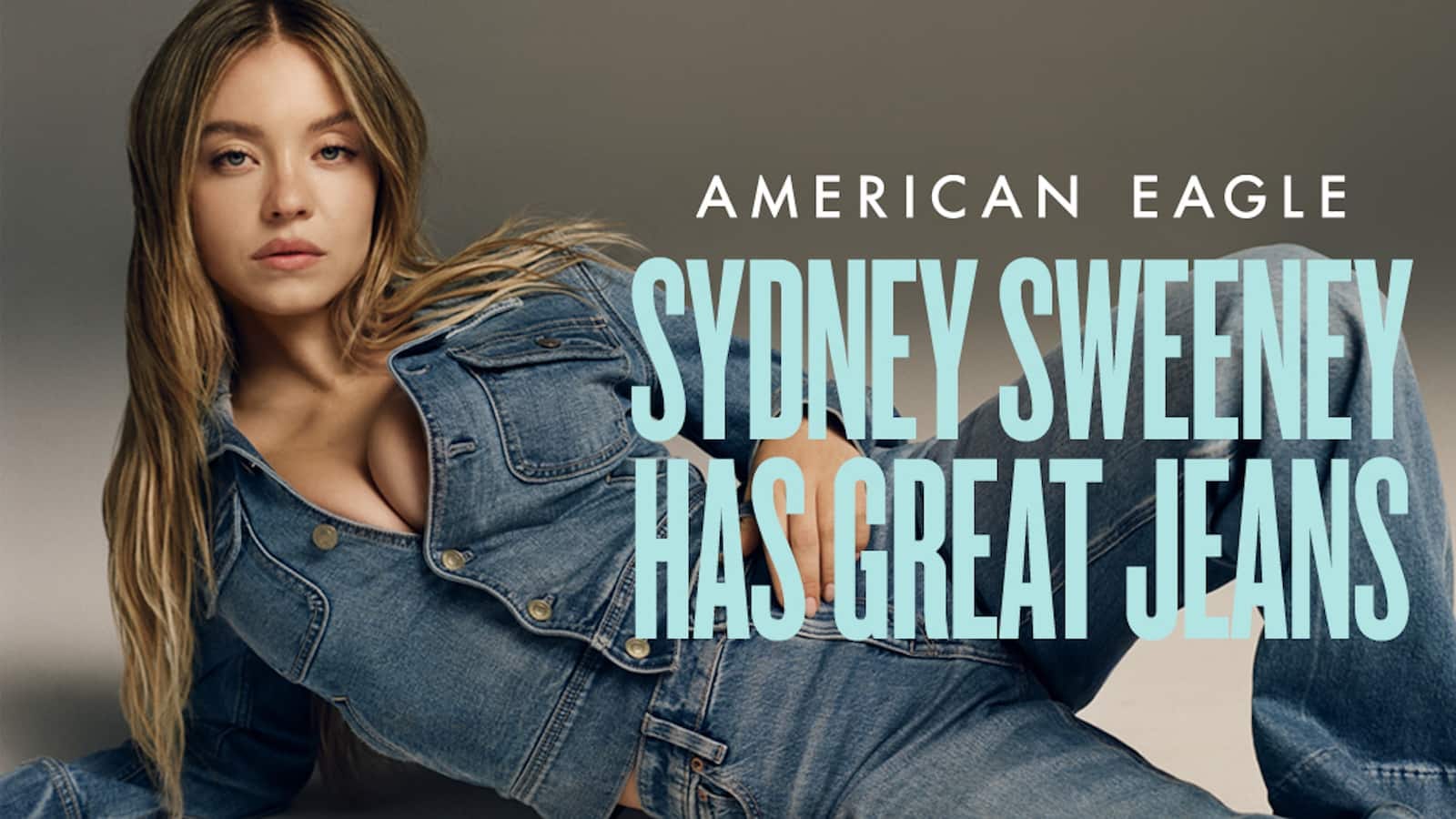
Before digging1 into the data, I should probably remind you of my original take when this ad first launched:
In my opinion, this campaign’s rage bait virality and meme-stock bump are heavily overshadowed by significant damage to the AE’s credibility with its target customers, who flooded social media with negative reactions.
At the time, I argued that this marketing miscalculation risked endangering the brand equity they’d spent the last decade building with Gen Z women, which revolved around an inclusivity-oriented positioning, particularly driven by Aerie. I believed that the drastic reverse-course towards Regressive Nostalgia might have blindsided their core demographic of young female customers, who are the primary target for 65% of the brand’s assortment.
According to the brand, my analysis was completely wrong.
Over the past year, American Eagle has been incredibly consistent in publicizing the apparent triumph of this campaign. Just a month after it launched — unfazed by the storm of backlash and buoyed by a soaring stock price — AEO’s CMO proclaimed:
Hands down, the ‘Sydney Sweeney Has Great Jeans’ campaign is our most successful campaign to date.’
The company, including CEO Jay Schottenstein, continued to crusade for the cause over the following months: celebrating a rise in new customers, crediting Sweeney as the driver of quarterly earnings growth, converting the situation into a lesson on ignoring social media commentary, and concluding the risk was a big bet they won. The brand has continued to feature Sydney for followups in April and July 2026.2
Speaking to The Wall Street Journal just last week, CMO Craig Brommers enthusiastically reiterates that the controversial ad was “a risk worth taking” because it was “ultimately…a very successful campaign for us.” He maintains that “a vast, vast, vast majority of people liked the campaign,” with consistency across demographic factors like “gender, ethnicity, political affiliation, geography.”3
Most mainstream news outlets covering this story have obligingly reported AEO’s press-release-version-of-events as reality, without questioning these claims.
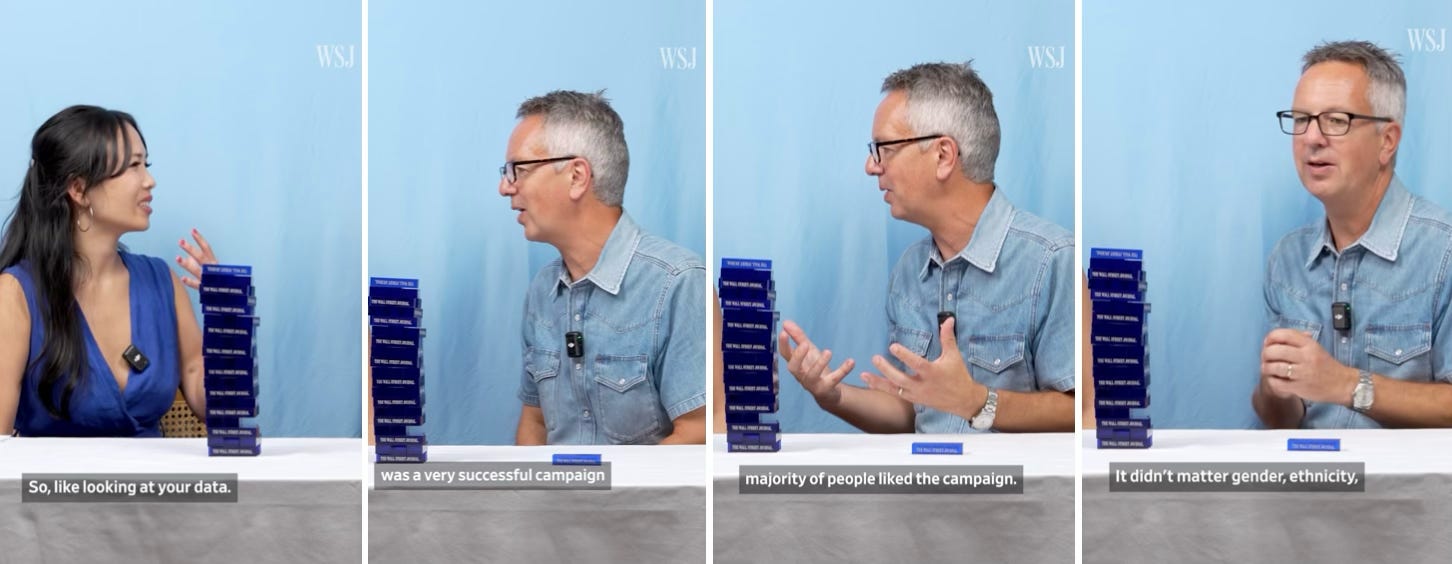
Yet, I have not seen any concrete evidence of this supposed success.
I like to maintain an openness to critique, and I’m willing to admit when I’m wrong.4 My initial read was an extrapolation based on cultural insight and my knowledge of the brand, so I was/am entirely open to the campaign’s results proving otherwise. Driven by that curiosity, I’ve been tracking this story closely over the past year, but…
All of the data that I’ve found suggests the AE x Sydney Sweeney “Great Jeans” campaign failed to drive brand growth or brand health amongst its target customer base.
After reading, let me know if you’ve seen anything that actually proves otherwise.
Brand Health: Consideration Slumped
Tracksuit’s brand health data helps us investigate the campaign’s impact beyond the short-term spike in media attention and largely meaningless social engagement.
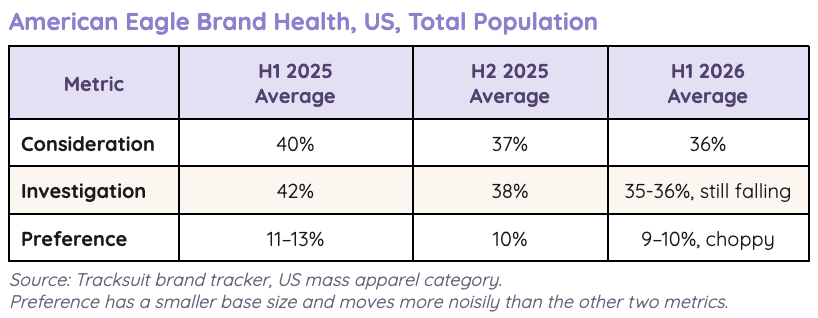
As a well-established brand, American Eagle’s prompted awareness barely shifted in the months following the controversy. But the key metrics of consumer Consideration and Investigation (people actively looking further into the brand) saw some declines.
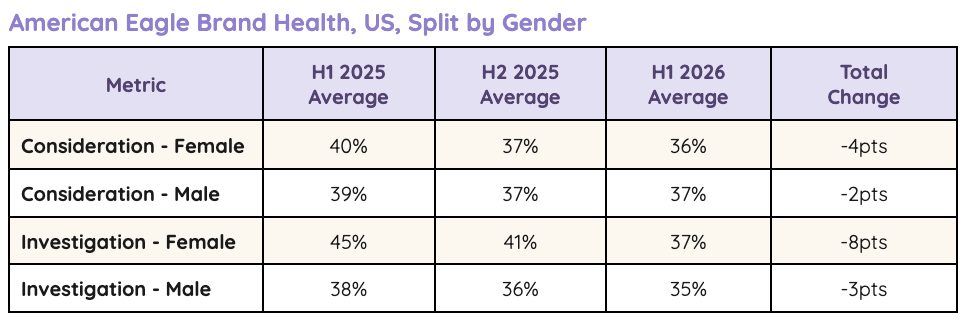
Splitting the data up by gender, we can see that women’s Consideration fell -4pts (vs. men’s falling -2pts) and Investigation dropped -8pts, (vs. men’s decline of -3pts). This corroborates my hypothesis that the campaign specifically endangered the brand’s relationship with its female customers.
But the real story comes into focus when we slice the data by age.
In the six months following the launch of Sydney Sweeney’s “Great Jeans,” younger shoppers — American Eagle’s core target market — pulled back hard: Consideration among 18-24 year-olds fell roughly 15-16 points, from 48.5% to 32.4%.
That’s quite a steep drop to see after spending millions of dollars on a campaign.

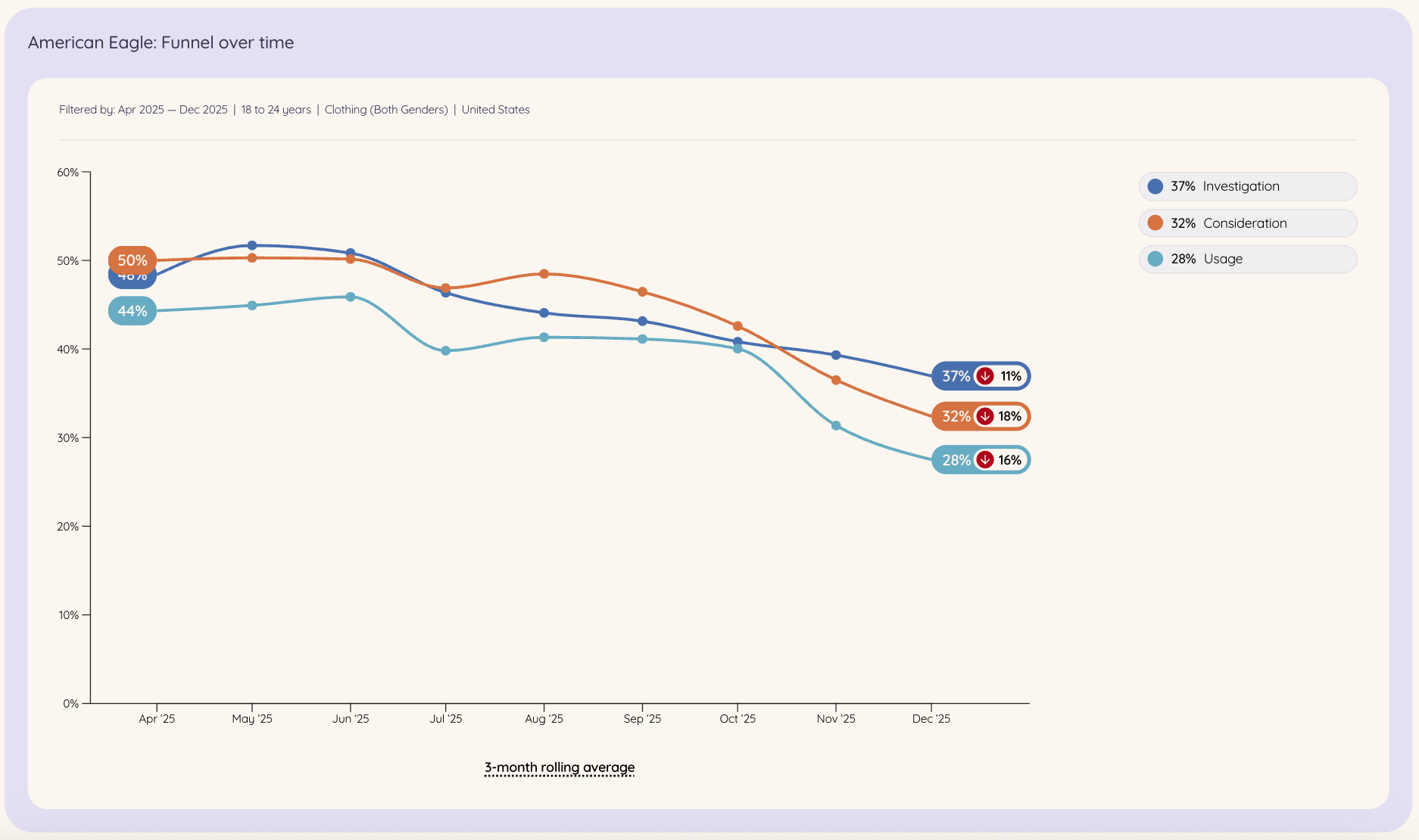
A contrarian might argue that other brands may have seen similar declines in customer sentiment, simply based on economic conditions. For a point of reference, we can look to Gap, which launched its own denim campaign after American Eagle’s.
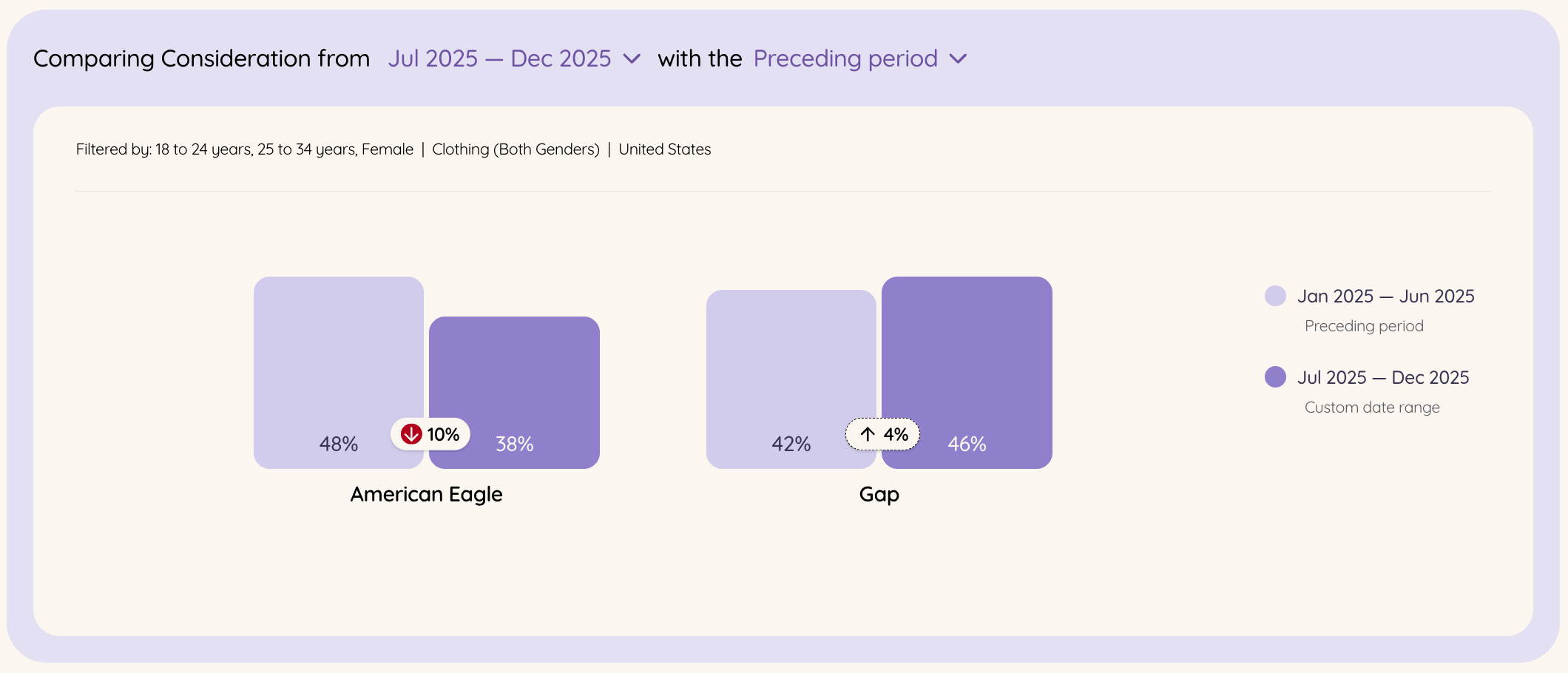
Tracksuit enables us to compare both brands’ Consideration metrics amongst 18-34 year old women across H1 2025 vs H2 2025 six month averages. Despite starting 6pts ahead, Sydney Sweeney’s “Great Jeans” successfully managed to forfeit American Eagle’s lead in the second half of the year. For this segment, AE’s Consideration dropped dramatically from 48% to 38% (−10 pts), while Gap’s increased from 42% to 46% (+4pts).
And the data doesn’t depict an ad-induced temporary turbulence with a quick bounce back to baseline. Instead, both female and young consumers were apparently unconvinced by the brand’s PR spin, because they maintained declining disinterest for months after the campaign, and even into the following year: As of H1 2026, American Eagle’s consideration amongst women averages at 36.3% (-4pts vs. H1 2025) and amongst 18-24 year olds averages at 40.7% (-8pts vs. H1 2025). In short, the brand has still not recovered from the negative impact of last summer’s campaign.
Is the structural erosion of brand health amongst your core customers a worthwhile tradeoff for a short-lived spike in media attention?
WHAT’S ANU is a reader-supported alternative trend resource.
Paid subscriptions unlock access to all past posts, occasional exclusive content, the complete 2026 Macrotrend Report, Quarterly Updates, and the Research Database.
Your support is appreciated!
Brand Growth: Sales Flatlined
After the campaign, American Eagle enthusiastically told the press that the controversial campaign directly contributed to “strong quarterly results” for both Q3 and Q4 of 2025. Indeed, the parent company AEO saw sales growth of +4% and +8% for each quarter, respectively.
But that growth did not come from American Eagle. It came from Aerie.
Despite all of those alleged new customers, American Eagle’s actual comp sales dragged down the company’s quarterly earnings averages. In contrast, Aerie has logged consistent double-digit sales growth for the past three quarters. And, in the aftermath of the campaign, the gap isn’t closing — it’s widening.
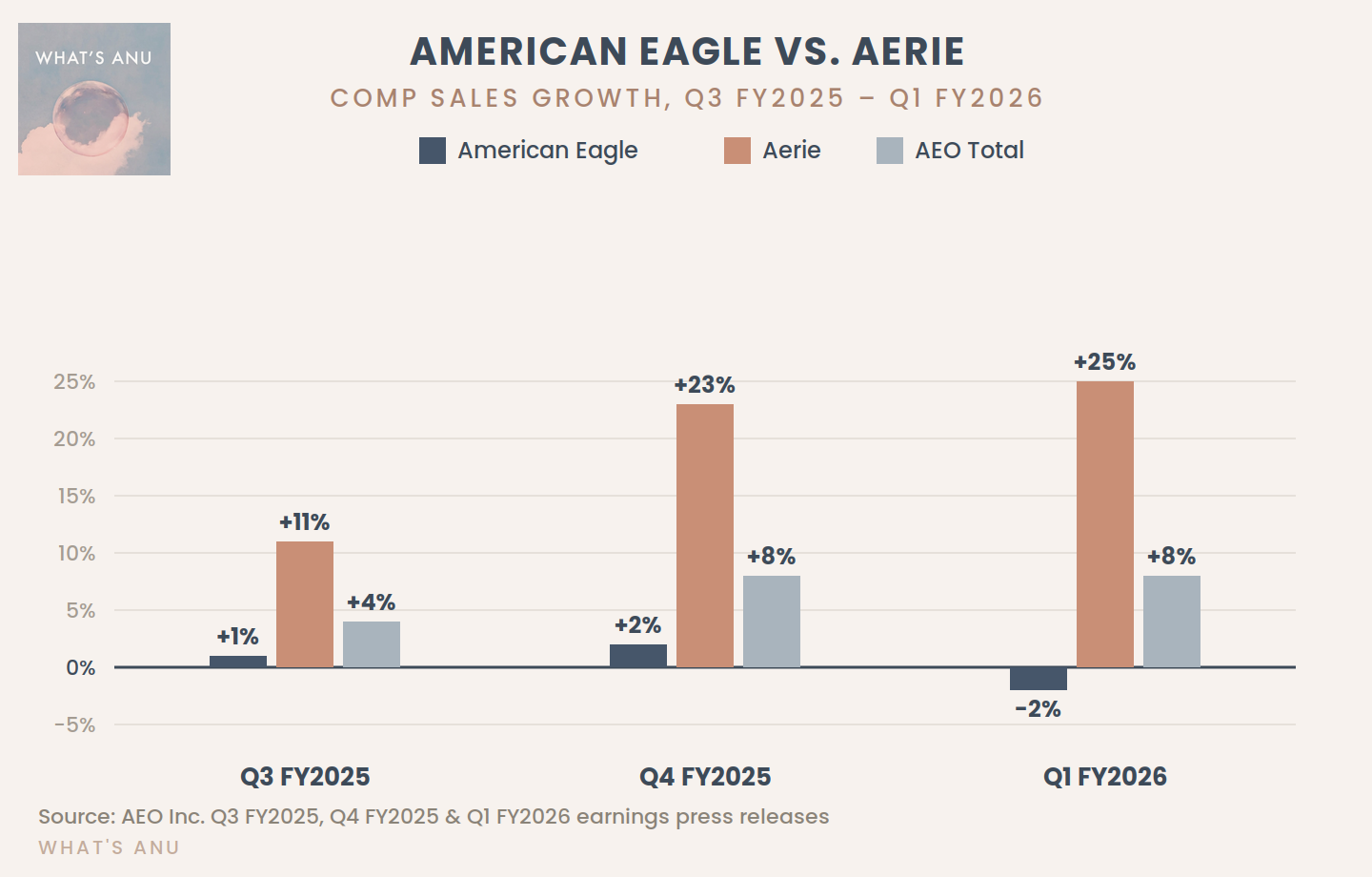
The company managed to bury American Eagle’s flatlining sales by publicizing the AEO total averages and slyly misattributing the company’s overall growth to Sydney Sweeney’s “Great Jeans.” This tactic worked for quite a while — they managed to obfuscate the truth for nearly nine months. (Which, I suppose, is a testament to a very strong corporate comms strategy!)
After the Q1 2026 earnings report was released at the end of May 2026, the faux-fable fell apart. A -2% decline in sales was a more obvious tell, and the brand had to admit, to some extent, that their strategy was not working. In the recent articles discussing the decline, Brommers (AE’s CMO) and Schottenstein (AEO’s CEO) are noticeably absent as spokespeople. Instead, AE & Aerie President Jen Foyle was tasked with handling the press this time.
Perhaps most ironically: Foyle confessed that the root of the malaise is their largest category, women’s bottoms…aka women’s jeans.
I think it’s pretty clear from these results that American Eagle’s big bet on Sydney Sweeney did not contribute to any positive sales growth at the company.
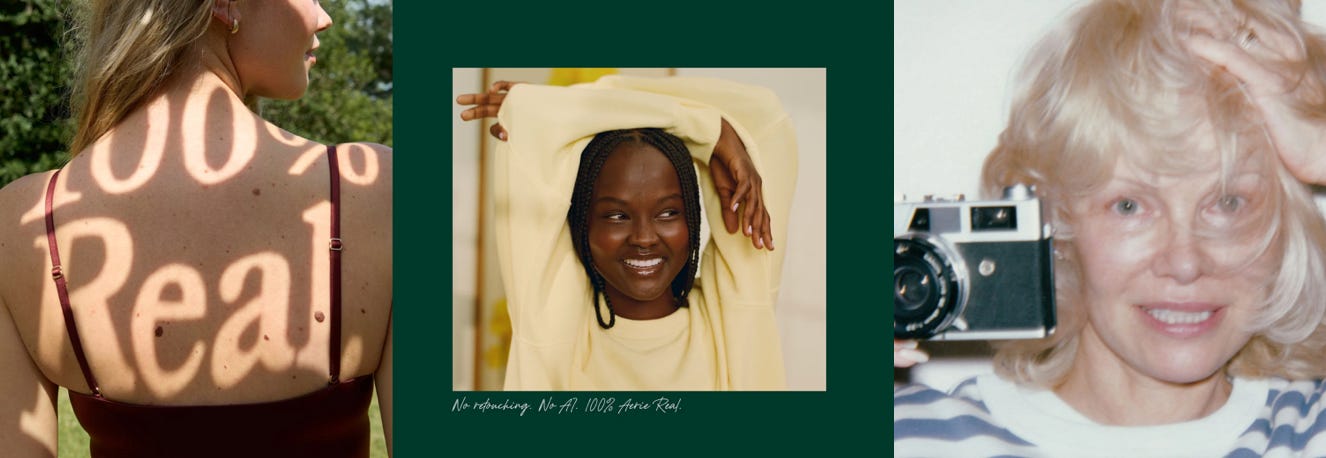
Meanwhile, as American Eagle struggles, it’s extremely obvious that Aerie is having great success, evidenced by its impressive sales numbers. Led by CMO Stacey McCormick, Aerie’s marketing and social media has pointedly avoided any association whatsoever with Sydney Sweeney . Their biggest push over the past year has been expanding the longstanding Aerie Real brand platform to incorporate an anti-AI pledge, and doubling down with a campaign featuring Pamela Anderson.
Notably, according to Tracksuit’s data, Aerie’s core 18-24 audience shows no net damage at all over the past year. The brand that stayed out of the story kept its young audience intact, and the brand at the center of it didn’t.
Although these two brands are both housed under AEO and helmed by the same CEO, they seem to be pursuing drastically divergent cultural strategies under two different CMOs. I find this really fascinating, and I would love to know whether it is purposeful. Do they truly believe that they are targeting the same customer with both of these approaches? Or are they intentionally splitting their bet between two segments?
And was the investment in Sydney Sweeney really worth these results?
About the stock price…
Any time I present the above evidence there’s always someone in the comments pointing to the stock surge, so perhaps it’s worth addressing preemptively:
First of all, we can quite easily establish that the post-campaign surge was fueled by some overeager dudes on r/wallstreetbets.

It is also clear that this meme-stock-bump was temporary, as they tend to be. The gains are fading — since the price peaked at $28.46 in January 2026, it’s now dropped ~37-40% and currently trades around ~$17-18. This is still higher than its pre-campaign price ($10.82), but that value increase is largely validated by Aerie’s impressive growth.
An additional note: AEO has been actively buying back stock: $256 million in repurchases in FY 2025, which decreased the number of available shares -8.71% in one year, plus an additional recorded $53 million in repurchases in Q1 2026. I don’t know a ton about the stock market if I’m being honest, but according to Claude, this “mechanically props up the per-share price and shrinks the share count — it’s not the market ‘discovering’ new value, it’s the company using its own balance sheet to concentrate ownership.”
All said, the stock price is still up, and that adds financial value to the company, at least in the short-term. But is that worth the tradeoffs of declining brand health amongst the core consumer target and slowing sales in the largest product category?
As market conditions continue to become increasingly divorced from consumer realities, I wonder if more brands will soon have to grapple with these types of questions…
The Trend Strategy Takeaway
The “Great Jeans” campaign leveraged Regressive Nostalgia-coded creative choices that alienated American Eagle’s target demographic: young women. The brand attempted to tap into the conservative cultural shift of the moment, but failed to consider the gender divide in sociopolitical sentiment among Gen Z men compared to Gen Z women (recall: primary target for 65% of the brand’s assortment).
This AE debacle validates the value of trend strategy. Regressive Nostalgia is not the same as a “microtrend” like ‘tomato girl summer.’ The first is deeply influenced by sociopolitical drivers, while the other is a superficial aesthetic fad. It’s clearly important for brands to understand the difference: you can’t tap into the semiotics of conservatism and expect consumers to believe it’s innocuous.
In my piece on Trend Bipolarity, I explained that the current polarized cultural climate can offer brands a unique opportunity to take a strong stance on controversial issues with the understanding that means purposefully alienating, or even enraging, people who are not your customers.
The Sydney Sweeney campaign sort of did this…in reverse.
American Eagle chose a stance that aligned with a specific demographic — Reddit bros who dutifully pumped the stock price. But they damaged their credibility with their core customer — young women who buy their jeans. And the negative impact went far beyond social media backlash.
But moving forward: The brand’s new country music-focused campaigns with Ella Langley and Bailey Zimmermann tap into the same macrotrend in a way that makes much more sense for their key target. Their Lamine Yamal partnership is a huge win for them in the global men’s space. And I think there is much more they could be doing in tandem with Aerie.
So, I’d bet that AE will turn things around. But it won’t be because of Sydney Sweeney.
Tracksuit is a brand health tracking platform that gives marketers continuous, always-on visibility into how their brand is performing on the metrics that predict long-term revenue growth.
If you enjoyed this post, please consider liking, commenting, or sharing.
See, I’d like to use “delve” here but apparently that might flag my work as written by AI. All writing is my own. I have, as always, clearly quoted/cited the specific instances where I did use Claude, i.e. to make one of the charts.
Although, I’m not seeing the recent 4th of July and BTS campaigns posted on their Instagram page…
I, for one, envy the level of delulu required to say this with conviction when there is no publicly available evidence backing up that statement.
As a Libra, I am committed to being a thorough investigator and fair judge 🕵🏽♀️ ⚖️ 👩🏽⚖️
Again, I can’t believe this is free! Such amazing work 👏🏻
fabulous analysis, Anu. i am going to tell the powers that be at my work about Tracksuit because I just do not trust the metrics we get from the platforms (Google meta etc) themselves.