
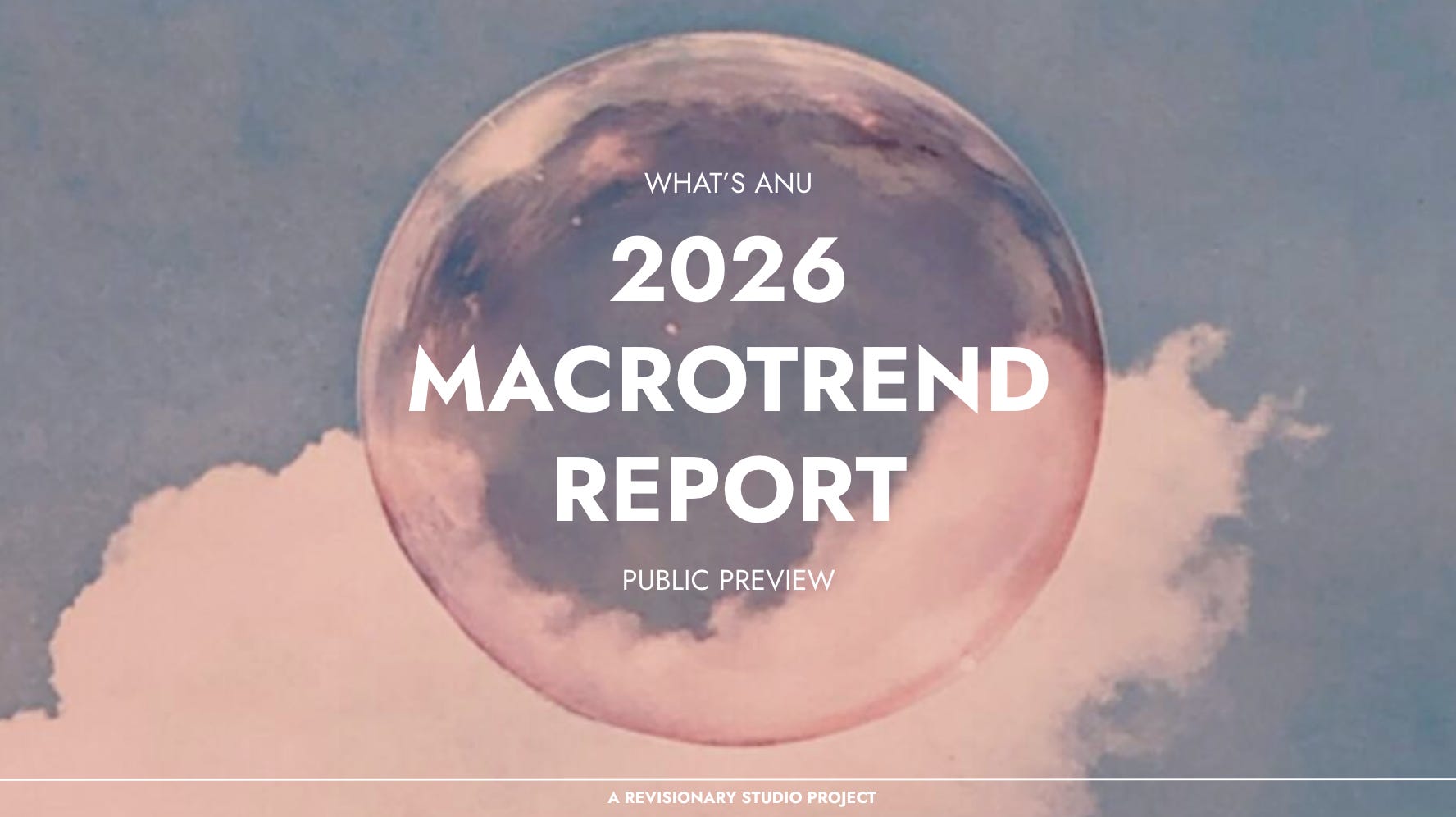
2026 MACROTREND REPORT
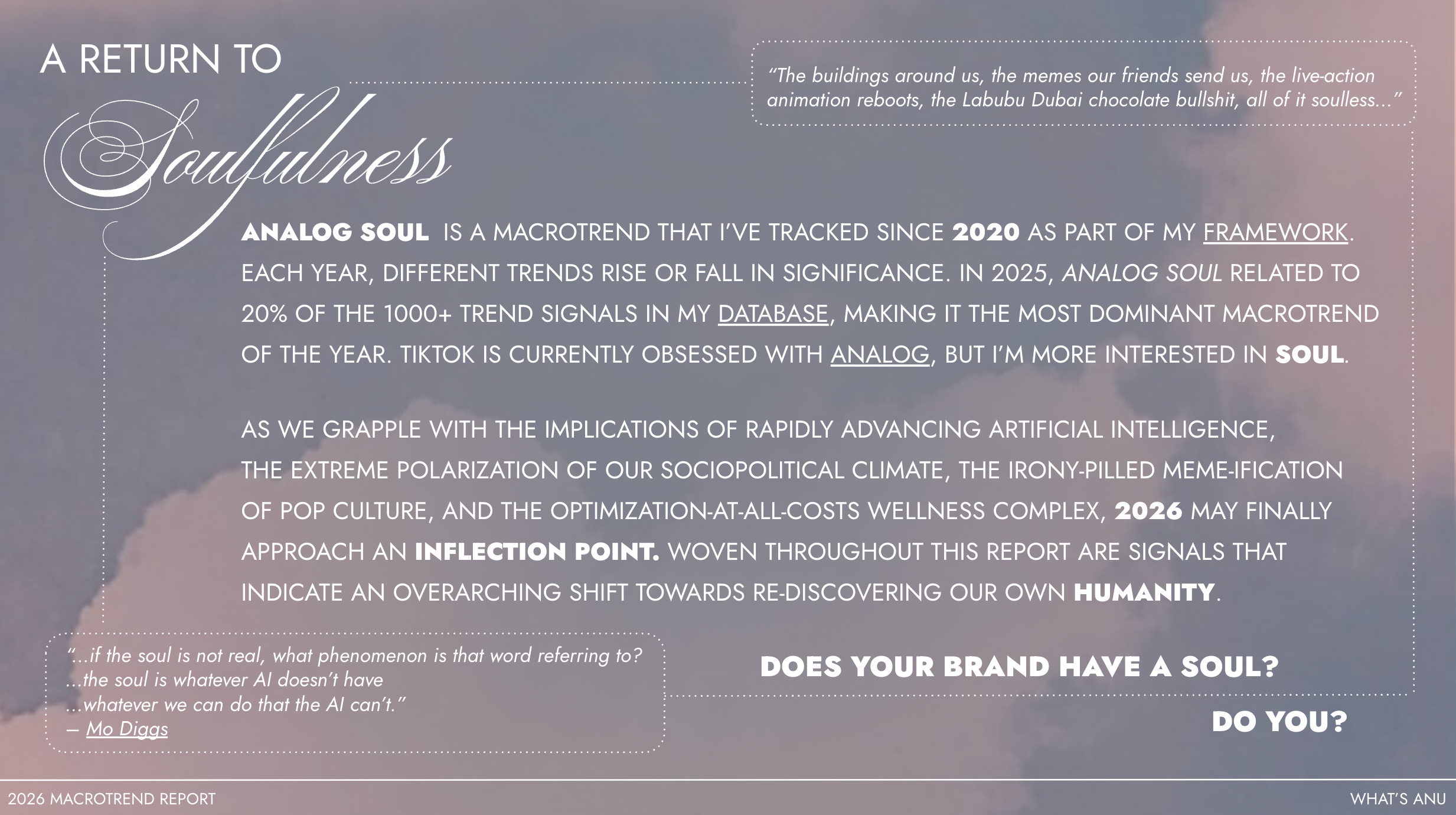
A Return to Soulfulness

Happy New Year! More details below, but: Here’s the report.
It’s been one full year since I started writing this newsletter, and I just want to thank you all for your kind words, constructive critiques, enthusiastic engagement, and generous restacks/reshares/referrals. I appreciate you <3
+ Welcome to the many new readers who recently subscribed! For those of you who may have missed it, I had the opportunity to share my media diet with Why is this interesting? earlier this week.

If you’re new here, you might want to read this post about my approach to trend research, before reading the 2026 Macrotrend Report. But it’s not totally necessary, because I intentionally tried to write this deck to be shareable and understood by anyone who might come across it.
Today’s shareout is a public preview. The final version will include completed pages for the remaining 12 macrotrends and 5 category snapshots (and will be published by the end of this month). This will only be accessible to annual paid subscribers. Alternatively, if you refer 10 new subscribers, you’ll also receive the final report.
My 2026 Macrotrend Report is different from most other ones. It does not include snappy hot takes, mention of “predictions,” consumer data, or cool graphics. It does include a clear methodology and framework, and lots of insight and inspiration.
🔮 Re: Predictions. You’ve likely encountered many, many predictions over the past couple of weeks. A few days ago, Casey Lewis sparked a conversation about the prediction hot take economy with this note, and I enthusiastically joined the prediction-hater brigade.
I’ve always felt uncomfortable with using the word “predict/prediction.” I think it sounds too concrete, while the future is malleable. And it simultaneously sounds too unmoored, like the idea was divinated out of nowhere, whereas understanding trends requires deep research, pattern-matching, and synthesis. In my opinion, there’s a reason why the field is referred to as “forecasting” or “foresight.”
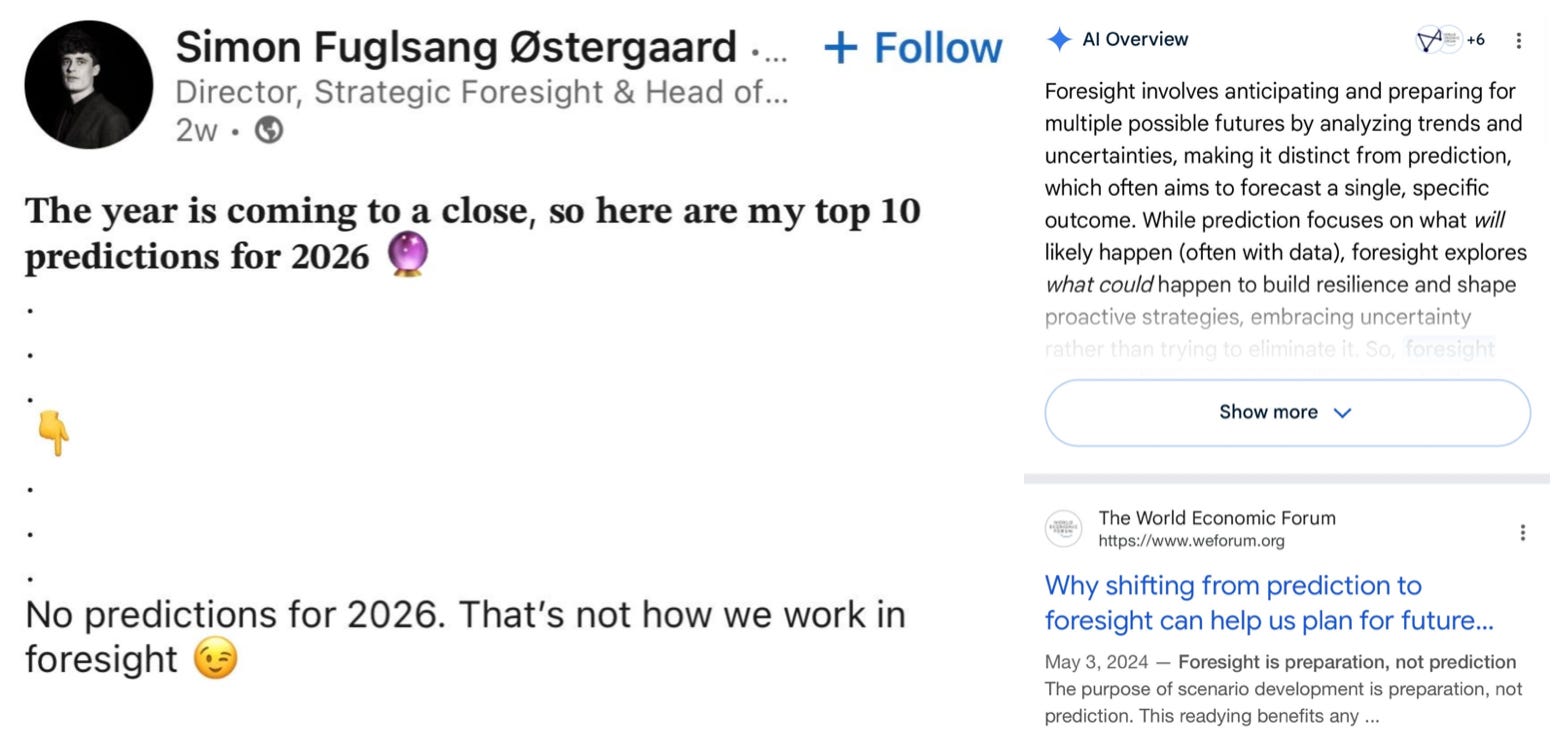
Forecasting suggests casting forward based on studying what occurred in the past and tracking what is currently happening. You can’t technically forecast without doing any research. A prediction can be based on research, too, but it can also be an entirely unfounded hot take, like we often see from Tiktok Oracles. That’s why I bristle a bit at its use — I just fear that it devalues the work, similarly to what we’ve seen with the confusion between ‘trending’ vs. trend.
As Simon explains, foresight is not actually meant to be about predicting the future, it’s about anticipating, planning, and preparing for multiple possible future scenarios. My approach, which I call trend strategy, aims closer-in than traditional foresight. When I write a trend report, or an essay for this newsletter, I’m interested in either: making sense of a convoluted cultural shift, tracking the evolution of macrotrends to uncover strategically relevant insights, or researching emerging signals as sources of inspiration for new thematic propositions. And in my strategy work, I help brands capitalize on those learnings.
All that said, while predictions are not my priority, they’re sometimes a fun byproduct of my work. I certainly don’t hate it when I’m right! And I will gladly answer any of your requests for predictions, like those that I was recently honored to share with The Wall Street Journal & GOOD THINKING (here).
That’s all for this week — hope you enjoy the trend report!
BRB just off to ask all my clients if their brand has soul...
Thanks for sharing so much of your report publicly.
I like to think of the role of foresight speculation as "tools for rehearsal"- as in, what can I do to prepare for a world where this speculation manifests? Is this a speculation that I want to rehearse towards, or away from? That helps keep the focus on the agency aspect.