

Note: This was originally published as a guest post on Sociology of Business.
Who Killed Cool? was a sort of prelude to the working theory I’m sharing today, Trend Bipolarity, which I’ve similarly been contemplating for several months. As you may, or may not, have read in those footnotes —
Popular understanding of trends might (reductively) suggest that they reflect what culture defines as cool: what’s on-trend is cool; and what’s off-trend is uncool.
Consequently, the collapse of cool would mean the collapse of the trend cycle.
So when I concluded by saying that brands should stop chasing cool, did I also mean they should stop chasing trends? Kind of. The hyper-speed commodification of cool means that chasing any specific trend cycle is an increasingly futile endeavor. The vibeless summer of 2025 pushed trend-confusion to a frantic fever pitch of trend-panic, with many wondering whether “trends are dead.”
Trends are not dead. We just need to change how we think about them. As Nikita Walia has noted, “Perhaps we aren’t seeing the end of trends so much as the end of neat, seasonal packaging.”
Trend Strategy is more important than ever before. This means understanding the macro trend landscape, consistently tracking its evolutions, and strategically leveraging the trends that make sense for your brand. Taking a macro view helps clarify what we are witnessing daily at a micro level:
The polarization of our sociopolitical and economic climate is directly reflected in the bipolarity of cultural trends driving consumer behavior.
Trend Bipolarity borrows from political science terminology describing the state of international relations at any given time as unipolar, bipolar, or multipolar. We know that we no longer live in a unipolar world (one undisputed global superpower), so why are we still attempting to decipher trends from a unipolar perspective? Why are we pointlessly trying to pin down whether it’s minimalism or maximalism; optimization or pleasure; irony or sincerity? Maybe, it’s both, at once.
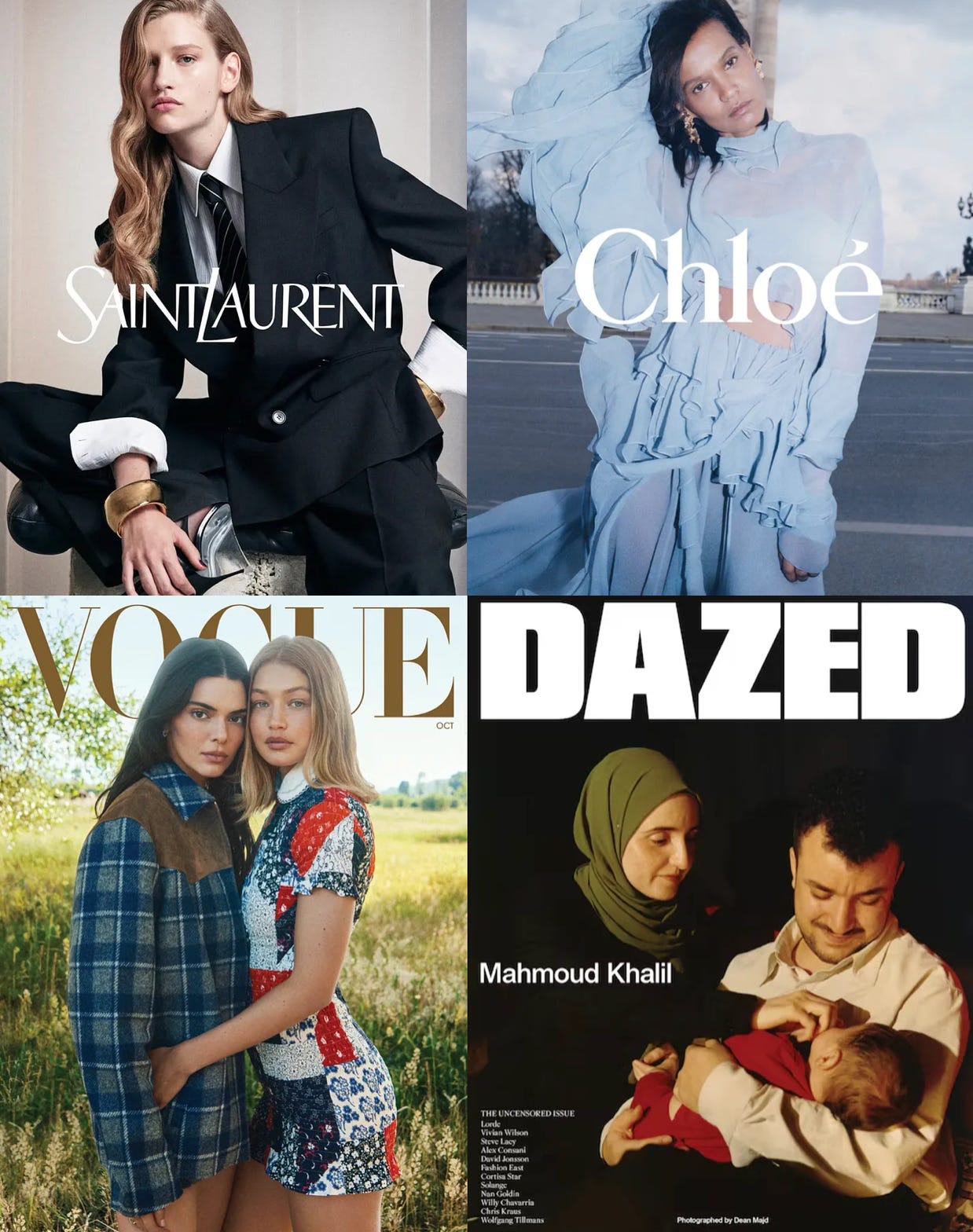
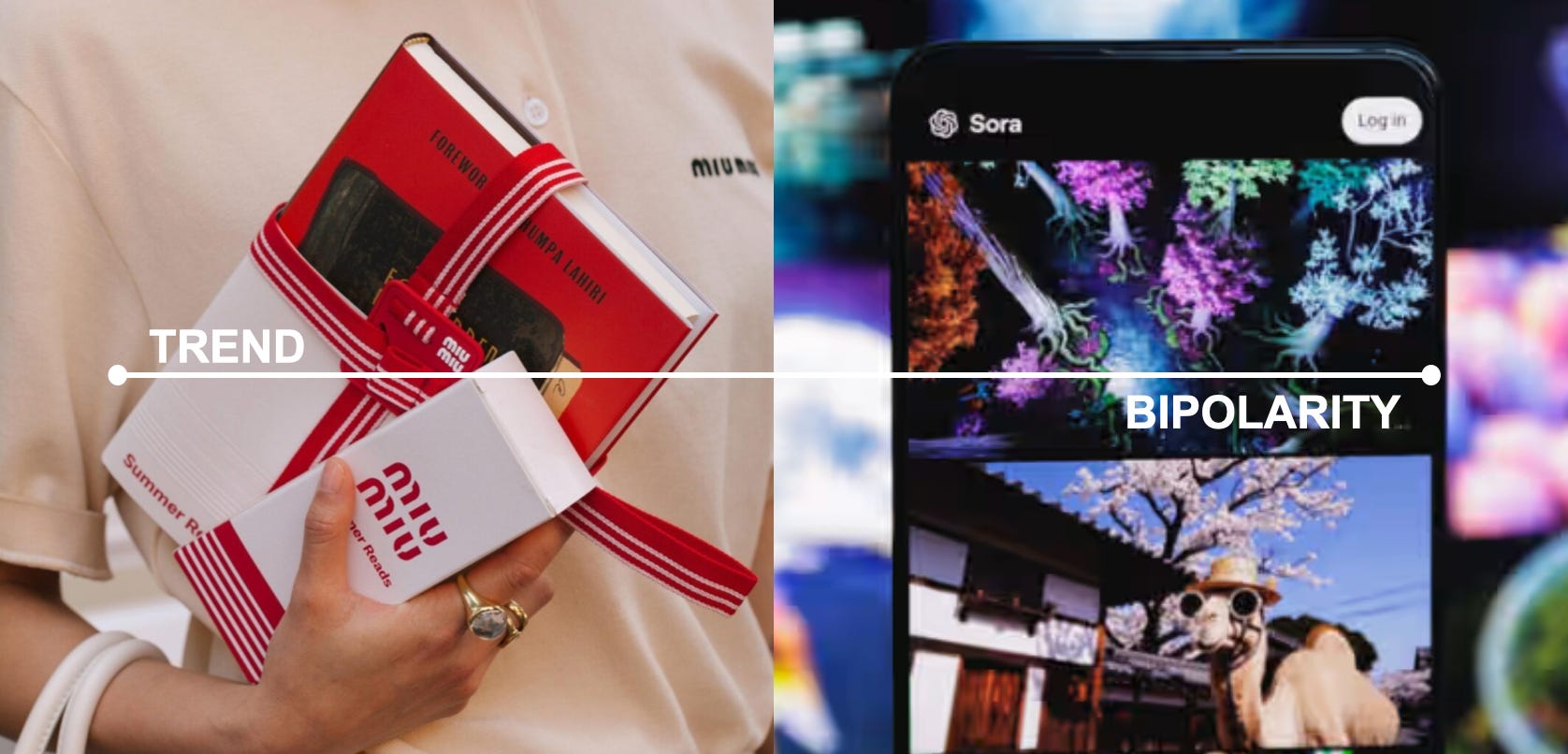
I first discussed how polarization was showing up in fashion trends in my Boom Boom vs. Boho report at the start of the year. More recently, the same concept of bipolarity resurfaced when my note comparing the Vogue vs. Dazed covers went viral. These polarized signals are everywhere: AI-generated content is booming, and so are reading retreats. David bars promise to help you protein-maxx your way to a perfectly optimized physique, while Zyn and nicotine energy drinks offer new ways to indulge in pleasurable vices.
It’s worth a closer examination — How did we get here, and how can brands approach Trend Bipolarity in practice?
Let’s start from the beginning…
The Trend Cycle
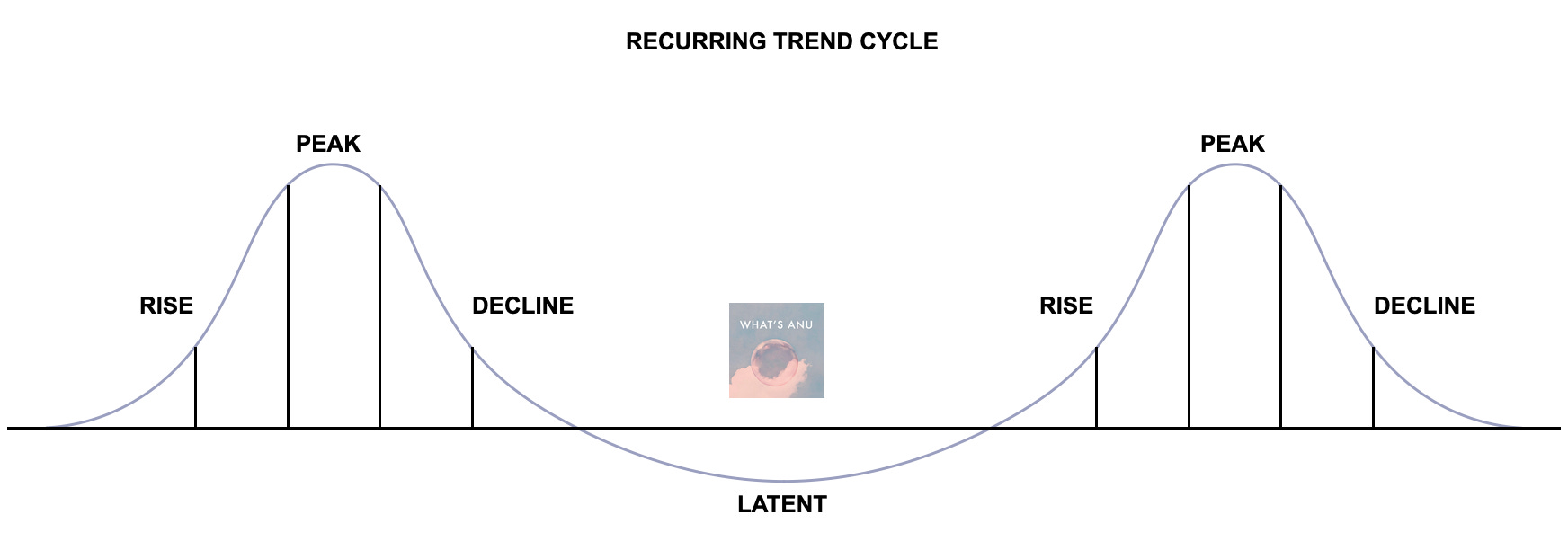
The most common way the ‘trend cycle’ is visualized is along a bell curve:
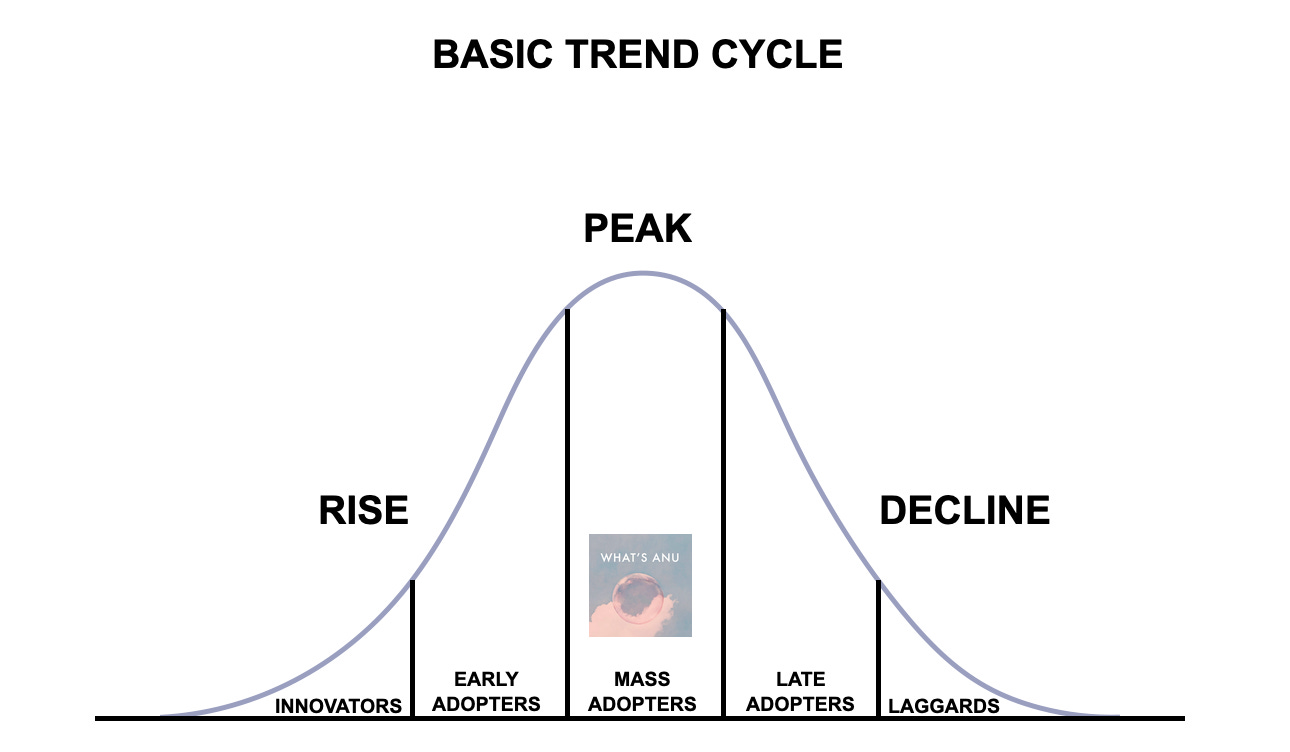
In many cases, trends are recurring (hence, cycle). This means that the curve repeats after a period of latency:
Additionally, most trends have a counter-trend (oppositional force), which creates what is often referred to as a “pendulum swing.” You can think about it as two recurring trend cycles overlapped. Here, I’ve used minimalism and maximalism for a simple visualization:
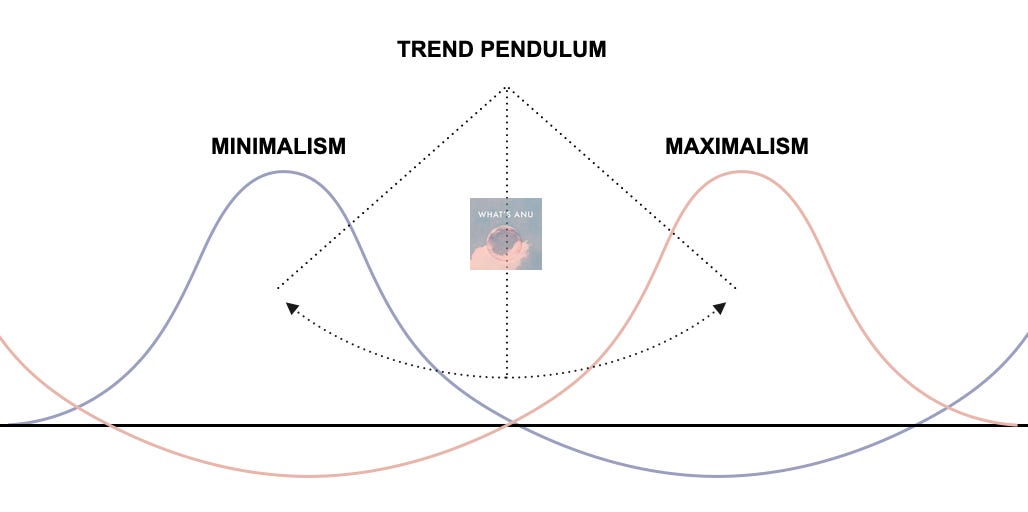
These diagrams were once a helpful tool to identify where we were located within a specific trend’s lifecycle, and to predict when a trend might reach, or pass, its peak. In a uni-polar world, where a singular trend led the majority of market demand, trend strategy depends on being in the right place at the right time (which is different for a luxury brand versus a mass market retailer). This analysis can be useful for planning product design, merchandising, and marketing strategy based on trend timelines.
Instagram sped up the pace of the cycle, but its general structure still remained intact for most of the 2010s. Tiktok initiated a more intense acceleration.
At this point, the cycle has collapsed, and it looks more like this:
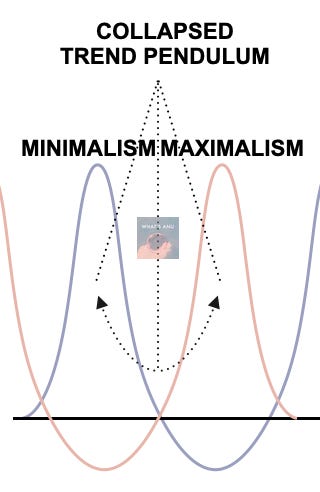
This collapse is what led me to suggest that the cycle is not just getting faster, it’s flattening into a straight line, and the pendulum is swinging so aggressively that it’s about to fall apart…
In fact, one could argue that it has already fallen apart.
The cycle diagrams can still sometimes be a helpful tool to identify where we were located within a specific trend’s lifecycle. However, it is increasingly useless in predicting when a trend might reach, or pass, its peak.1 The collapsed pendulum is moving at hyper-speed, and unpredictably. This also makes it more susceptible to sudden disruptions and anomalies, which no longer average out over time. Where and when become less important indicators, if everything is everywhere, all at once.2
Trend Multipolarity
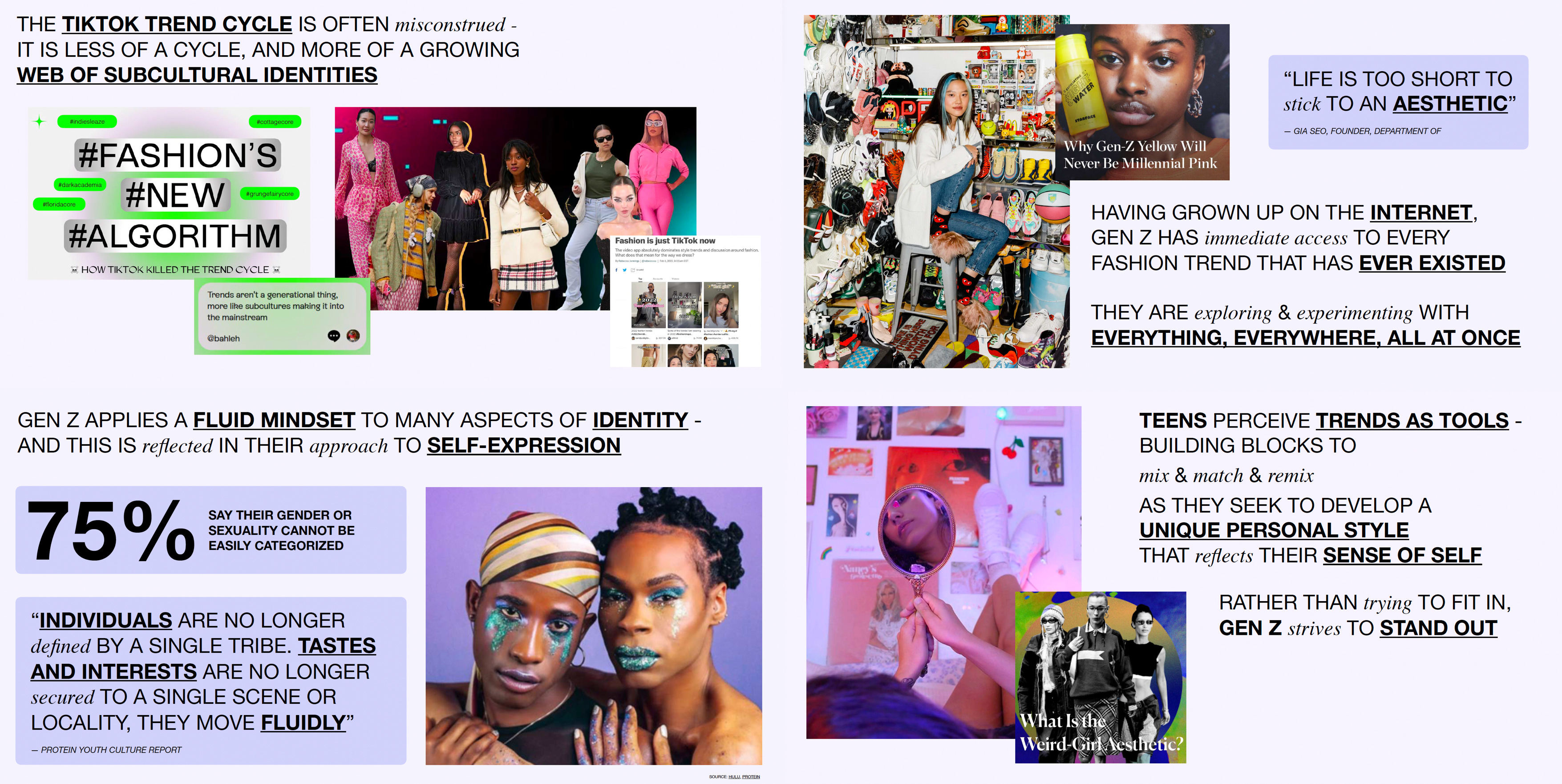
Back around 2020-2022, I felt that Tiktok’s influence on cultural niche-ification and fractalization was driving a multi-polar state of trends. Over the past few years, this has become progressively more clear. As Katherine Dee recently articulated:
“The identity is the act of aesthetic curation itself. The ability to navigate between different modes, to know when to deploy which references, to remix and synthesize—that’s what matters now. These fads are our monoculture.”
This why I initially began developing my Macrotrend Framework in 2020, to help make sense of things. I thought that we needed a different approach to thinking about trends because multiple cultural currents were rising, declining, and evolving at the same time — several trends cycling at once, often intersecting.

The framework enables all 12 macrotrends3 to be visualized and tracked simultaneously, to quickly draw out connective themes, and to identify emerging opportunities. It also offers an easy way to identify the specific macrotrends that best align with your brand identity, so that you can double down on investigating and activating against those. In a multi-polar world, trend strategy depends on leveraging any specific trend to your advantage (based on brand alignment) or marketing to multiplicity (of moods, styles, sentiments — best for a large retailer or conglomerate).
This can be challenging if you’re not clear on your brand positioning. As Zoë Yasemin has written, creative direction becomes more complicated when “every trend coexists” (multi-polar) because the direction of culture is no longer singular (uni-polar). However, this may be changing, again…
Trend Bipolarity
I still believe multiplicity is relevant, yet I feel that we may have entered a bi-polar state of trends. The fractalized landscape seems to be clustering across two opposing ends of a spectrum, with cultural sentiment and aesthetic ideals reflecting polarized political sentiment and socioeconomic disparity in our K-shaped economy.
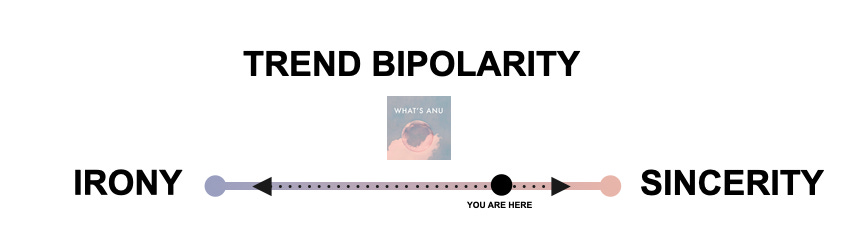
Trend Bipolarity is essentially trend vs. countertrend, but the difference is that one is not always more obviously dominant than the other for a significant period of time. The trend cycle collapses into a tension line, and movement across the line often feels random and erratic, unlike a predictable pendulum swing at a consistent tempo. For instance, I think the irony-sincerity “cycle” might now look more like this:
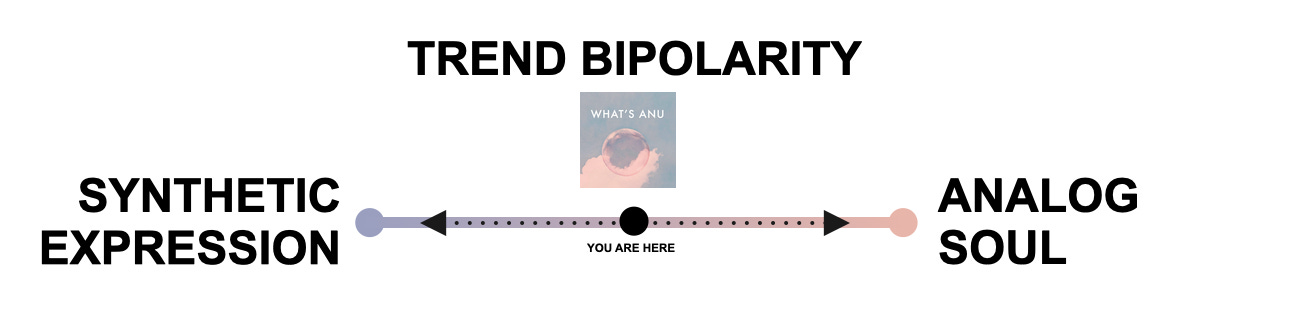
A clear example of how this theory of Trend Bipolarity applies to my Macrotrend Framework involves considering Synthetic Expression, which includes AI-generated content, in opposition to Analog Soul, which includes offline hobbies like reading and chess. Both of these opposing trends simultaneously feel relevant.
Another example is Functional Optimization versus Hyper Pleasure. I recently got in a very silly argument about this with someone on LinkedIn who claimed:
No one’s selling you pleasure anymore, they’re selling you optimization…the “Sensory Marketing” label misses the mark: it assumes people still buy for pleasure…That made sense when food & beverage brands were consumed for taste experiences, but today we optimize. Food is consumed purely for function.
But I don’t think this is true.4 People do still consume for pleasure. While health-focused optimization may feel dominant right now, we have simultaneously seen “cocaine induced opulence” and sex-centric campaigns. Pleasure-focused products and sensorial marketing remain highly relevant. Which trend is more important for your brand to activate against is entirely dependent on your specific category and target consumer.

As a strategic tool, Trend Bipolarity provides a framework for sensemaking. Here are a few ways how brands could leverage trends in a bipolar world:
1. Holding Against Trend Bipolarity
This approach is fairly simple. Brands with well-defined identities can hold onto their strategic positioning and aesthetic codes regardless of whether they are currently considered ‘on trend.’ A brand like Ralph Lauren, might currently be benefiting from the resurgence of prep, but only after retaining their preppy point-of-view through a lengthy period of latency. Brunello Cucinelli channeled “quiet luxury” before it was trending, and after, too. Patagonia is unbothered by whether “gorpcore” is dead.
Holding has always been a strategic option — you can choose to ignore trends in any state of trend polarity. But it can be quite risky to refuse following the trajectory of the market in a unipolar state of trends. Trend Bipolarity allows for a tempered version, via aligning your brand against various macrotrend tensions.
Returning to Functional Optimization versus Hyper Pleasure — for instance, if you are a makeup brand rooted in self-expression, you might decide to remain entirely focused on pleasure-related trends, despite broader culture leaning towards science-based optimization. There is less pressure to chase after optimization, because it is not a unilaterally dominant trend. There are still plenty of exciting microtrends to leverage in the pleasure space — it’s not latent, it’s still actively evolving.
Holding can make growth challenging. When pursuing this approach, it’s critical to prioritize trend-driven product innovation that generates excitement among your existing customers, and to double-down on values-based marketing that drives penetration and fosters loyalty amongst key target segments.
One interesting aspect of this strategy is that you can leverage Trend Bipolarity to take a stance on controversial issues. If you are a beauty brand, and the majority of your customers are women between the ages of 18-40, then the current sociopolitical climate means they have very divergent values from men their age. Your brand might decide to vocally support abortion rights, even though that means alienating, or even enraging, people who are not your customers.
2. Hedging to Manage Trend Bipolarity
Not every brand has the ability, or appetite, to hold. Another option is to hedge your bets against various Macrotrend tensions, while remaining agile and adaptable to fast-paced changes based on real-time monitoring. Managing a state of cultural trend bipolarity reminds me a bit of Nassim Nicholas Taleb’s barbell economic strategy, which I learned about via a kyla scanlon essay earlier this year:
Barbell Strategy: A dual strategy, a combination of two extremes, one safe and one speculative, deemed more robust than a “monomodal” strategy; often a necessary condition for antifragility. (Antifragile)
Examples, from a financial management standpoint, include strategies like keeping 90% of your net worth in cash, and 10% in a highly speculative asset, like Bitcoin. This asymmetric bet theoretically maximizes your potential upside, while offering protection from potential downside. Taleb’s idea is to avoid attempting to find balance in the ‘moderate’ space in the ‘middle’ of the barbell, which is prone to miscalculation.
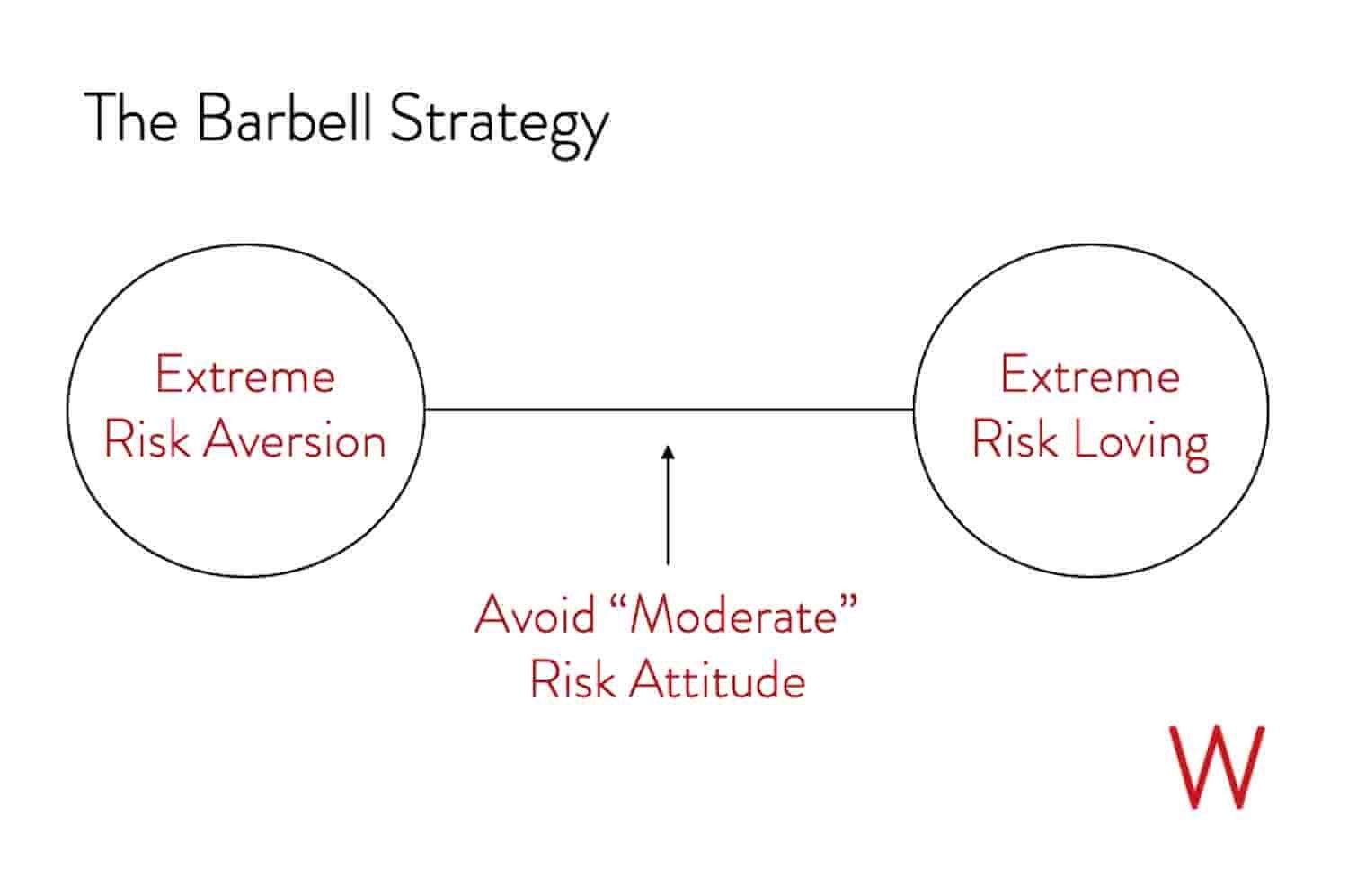
Applying this to trends could be an interesting solution for mass brands, multi-brand conglomerates, or wholesale retailers, which cater to large, diverse audiences and may not be able to strictly maintain a hyper-specific positioning.
Perhaps you are a major beauty retailer and, based on the trend towards Functional Optimization versus Hyper Pleasure, you might decide to pivot your assortment to heavily favor dermatologist-backed, high-performance brands, since this is the dominant skew in the current beauty market and thus a safe bet. However, you could still ensure you are stocking some pleasure and self-care focused products, too, to hedge against a sudden shift towards the opposite end of the trend tension spectrum. This type of unexpected reversal could happen overnight, simply because of a single celebrity, influencer, or viral meme.
If not possible via product assortment, trend-based hedging could also be accomplished through marketing, partnerships, and activations.
3. Mining to Magnetize Trend Bipolarity
Finally, perhaps the most difficult, and also the most powerful, trend strategy in the age of bipolarity might be mining the tension and balancing the inherent contradiction. Tension mapping is already a common strategic tool used in cultural insights work, as Jasmine Bina explains in a recent article.5 She highlights how brands, like American Apparel, have succeeded with this approach in the past:
When a brand can hold two opposing ideas without collapsing, like sex and idealism in American Apparel’s case, they reflect peoples’ inner conflict back to them, and that’s a magnetic energy to project.
I think a similar approach can be applied, on a smaller scale, to various Macrotrend tensions. One example comes from the recent article by Tom Garland. He exposes the emergence of The Wellness Anarchist, birthed from the industry’s dichotomy between high-performance versus athleisure, which tracks back to the same tension between Functional Optimization versus Hyper Pleasure macrotrends. Garland highlights how brands like Satisfy Running, Liquid Death, and Mental Athletic, cater to those who “sit in neither and both camps…This consumer trains seriously enough to complete marathons yet considers the afterparty equally important.” Embodying this internal contradiction is natural for humans but difficult for corporations. When a brand can mine a tension successfully, it becomes magnetic.
Takeaway
The endless race to capitalize on viral micro moments is a distraction from the reality of the macro trend landscape. Zooming out helps us understand the polarized trajectories that are defining contemporary culture. In the current climate, chasing a single trend cycle means falling behind. Instead, brands can carve out unique cultural opportunities by strategically leveraging Trend Bipolarity: holding, hedging, or mining relevant trend tensions.
I’m keen to start thinking about how Trend Bipolarity might map out across the entire Macrotrend Framework, but I don’t want to get ahead of myself. As I mentioned from the start, this is a working theory. I’m curious whether, or not, it resonates. I’d love to hear what you think, either way!
For example: You could still plot Labubus on the declining side of the bell curve…but it’s not clear how long that decline will take, or whether a memetic moment could instigate a sudden resurgence, bringing them back to their peak. Another example: We are currently seeing a rise of earnestness and sincerity, but it’s unclear how quickly that will peak and decline, primarily because of the hyper-acceleration of the commodification cycle.
In this climate, traditional fashion trend forecasting, like tracking runway trends and expecting them to trickle down to big box retailers in 1-2 years, becomes ineffective. Instead, it becomes more useful to think about larger cultural drivers and macrotrends, because from these we can extrapolate to forecast category trend trajectories.
Originally 12, now 13 because I added Regressive Nostalgia this year
The post also claimed that the optimization trend started a few months ago — whereas I’ve already shared here that it has been tracking since the mid-2010s (Soylent, anyone?). I just don’t think it is helpful to speak in sweeping statements or decontextualize trends from their historical trajectories — this reduces their effectiveness and causes trend overload. Nuance is key. I really did not mean to offend this person with my comment, but they got very defensive…I’m personally very open to and welcoming of constructive criticism, because it helps me learn and grow. Please feel free to challenge any of my ideas in the comments or via dm at any time.
I’d recommend reading Bina’s full piece for an overview of high-level cultural tension mining, and her thoughts on this era’s emerging existential tension.
First off. This is so smart.
Second: In 2003, maybe, perhaps, I was editing a magazine. I was in a new boutique property in New York. With the green apples. Driftwood as furniture in the bar. And in the bar, the same people: Germans in linen. Japanese couples with the latest digital devices. Eastern European model-types. Kids in polos from New Jersey. And it was the same scene at every boutique hotel I'd been to lately. A few months later, our cover story was about "the death of cool." Rinse repeat.
As a former IR major the mentions of polarity jump scared me lol, but I think this is a great reading of the zeitgeist. It's almost some other third thing, where two main poles are umbrellas for dozens of smaller (sometimes conflicting) subcultural trends, at least among my generation (gen Z)